More US Night Helicopter Emergency Medical Service (HEMS) Accidents
At the beginning of March 2015 we published an article on the aftermath of a 2003 fatal night-time US HEMS accident: Life Flight 6 – US HEMS Post Accident Review. During March 2015 there were two more fatal night-time medical helicopter accidents in the US.
Air Methods EC130B4 6 March 2015 St Louis
The first accident was during a night-time, post-fuelling, positioning flight, which killed the pilot, the sole person on-board. The US National Transportation Safety Board (NTSB) preliminary report states:
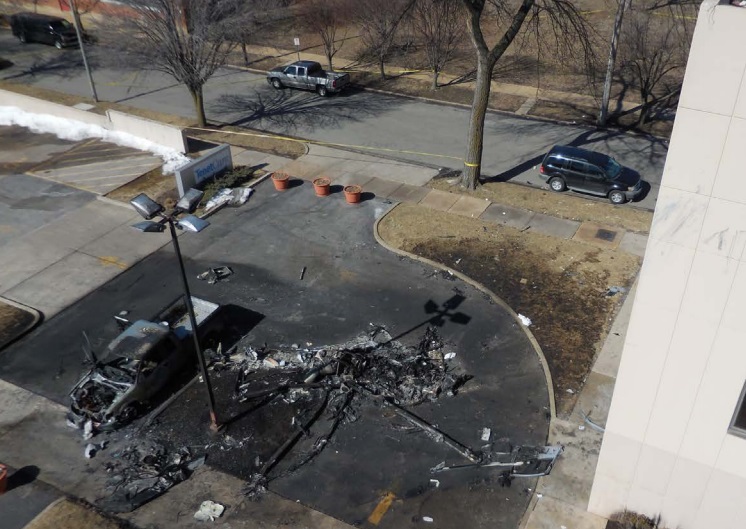
On March 6, 2015, at 2310 central standard time, an Airbus Helicopters (Eurocopter) EC130-B4, N356AM, operated by Air Methods (doing business as ARCH), struck the edge of a hospital building and impacted its parking lot during a visual approach to the St Louis University Hospital elevated rooftop helipad (MO55), St Louis, Missouri. During the approach, the helicopter experienced a loss of directional control and entered an uncontrolled descent. The helicopter was destroyed by impact forces and a post-crash fire. The commercial pilot, who was the sole occupant, sustained fatal injuries. The helicopter was operated under Title 14 CFR Part 91 as an air medical positioning flight that was operating on a company flight plan. Night visual meteorological conditions prevailed at the time of the accident. The flight was returning to MO55 after it had been refueled at the operator’s base in St. Louis, Missouri.
The flight’s first approach and landing at MO55 was to drop off a medic, nurse, and a patient. During the approach, the pilot reported to the flight nurse and medic that winds were gusting to 25 knots. The flight nurse stated that helicopter was yawing quite a bit and there was a noticeable roll side to side during landing. The helicopter landed without incident during the first approach and landing. The flight then departed to obtain fuel at the operator’s base and then departed to return to MO55, to pick up the medic and flight nurse.
The accident occurred during the return’s approach for landing at MO55.
Examination of the wreckage confirmed flight control continuity of the tail rotor drive system and there were indications consistent with engine power on the turbine wheel output shaft.
There was a post crash fire.
UPDATE 22 June 2016: The NTSB have now published their final report:
A security video showed the helicopter on a northerly flightpath descending at about a 45-degree angle before impacting the ground and coming to rest on an approximate northerly heading. The pilot sustained fatal injuries due to the subsequent fuel tank fire/explosion, which otherwise would have been a survivable accident.
EC130B4 N356AM Accident Site (Credit: NTSB)
A postaccident safety evaluation of the heliport showed that the final approach and takeoff area/safety area were obstructed by permanent and semi-permanent objects that pose a serious hazard to helicopter operations. These obstructions limited the available approach paths to the heliport, which precludes, at times, approaches and landings with a headwind. The helipad is privately owned; therefore, it is not subject to Federal Aviation Administration (FAA) certification or regulation.
A review of the helicopter’s flight manual revealed that there were no wind speed/azimuth limitations or suggested information available to pilots to base the performance capabilities of the make and model helicopter in their flight planning/decision-making process. Examination of the helicopter revealed no anomalies that would have precluded normal operation and showed engine power at the time of impact.
The National Transportation Safety Board determines the probable cause(s) of this accident as follows: The pilot’s decision to land during unfavorable wind conditions, which resulted in a loss of control due to settling with power.
Contributing to the accident were the lack of an adequate approach path due to numerous obstructions and the lack of available guidance regarding the helicopter’s performance capabilities in the right quartering tailwind condition.
Air Methods, a large player in the HEMS business founded in 1980, has had 6 air accidents in the last 5 years according to the Aviation Safety Network (plus one aircraft destroyed in a storm). Four were fatal accidents with 11 fatalities (Date/Type/Registration/Operator/Fatalities/Location/Cause):
Saint Louis University Hospital, St Louis, MO / TBD (NTSB Final Report Awaited)
UPDATE 13 April 2015:FAA Proposes $1.54 Million Civil Penalty Against Air Methods Corp for allegedly operating Eurocopter EC130 helicopters on dozens of flights over water when they were not in compliance with Federal Aviation Regulations in relation to floatation systems and life jackets.
EagleMed AS350B2 12 March 2015 Oklahoma
Less than a week later an EagleMed Airbus Helicopters AS350B2N919EM crashed at night in deteriorating weather. The crew had just transported a patient to Tulsa and was on a return flight back to the McAlester Regional Airport. The accident occurred at 23:25 local time. The medical personnel survived but the pilot died.
The NTSB preliminary report is awaited but according to NTSB Investigator Tom Latson, quoted by a local newspaper:
While en route the helicopter encountered lowering clouds, and the pilot had made the decision to return to Tulsa because of the lowering clouds.
During their left turn to return to Tulsa, they impacted trees and rocky terrain…
UPDATE 7 April 2015: The NTSB have now published their preliminary data:
During the previous northbound flight to transport a patient to the 4OK3 heliport, the pilot mentioned to the medical crew that he noticed that the clouds above their cruise altitude were lower than he expected. The pilot descended slightly and the helicopter landed at 4OK3 without incident. While on the ground the pilot checked weather again and after conferring with the medical crew they decided to begin the planned return flight from 4OK3 to MLC. The helicopter was southbound at a cruise altitude of about 1,500 feet msl when the medical crew reported the helicopter had twice briefly entered and exited instrument meteorological conditions.
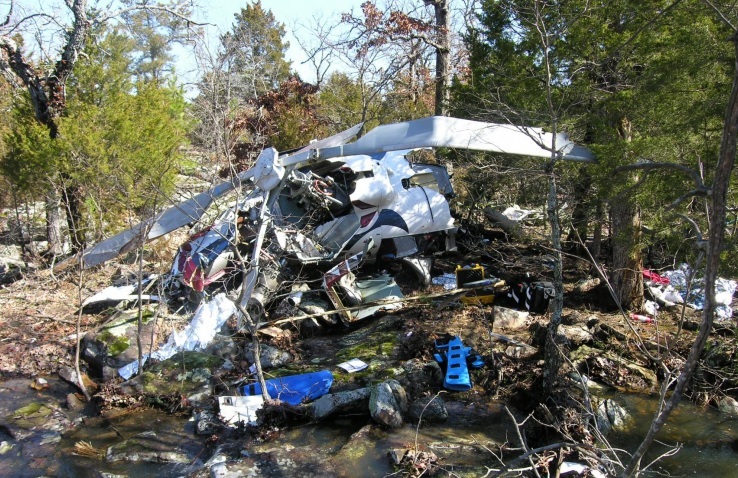
After a short discussion the pilot then stated he was going to divert, and he began a left turn to return to Tulsa, Oklahoma. Soon after beginning the left turn the helicopter impacted trees and terrain at a surface elevation of about 850 feet msl. The impact resulted in the separation of the tail boom and portions of the fuselage and the main wreckage came to rest on its right side. The helicopter’s fuel tank remained intact, there was no fuel leak, and there was no postimpact fire.
After impact the surviving medical crewmembers extracted themselves from the wreckage and immediately made a cell phone call to report their situation and location.
Wreckage of AS350B2 N919EM (Credit: NTSB)
Several agencies then used the position report from the crew, data from the on-board GPS position reporting system, and signals from the 406 MHz emergency locator transmitter to locate the wreckage. Emergency responders hiked in the dark night conditions through the remote rugged terrain and arrived several hours later.
UPDATE 23 May 2017: The NTSB have now published their final report:
According to the medical crewmembers, about midway to their destination, the helicopter entered instrument meteorological conditions (IMC). After a brief discussion, during which one of the crewmembers told the pilot to go “up,” the pilot stated he was going to divert to another airport because he saw lights, and he then began a left turn.
Although both crewmembers reported seeing trees and one of them told the pilot to “pull up,” shortly after , the helicopter impacted trees and terrain atop a wooded hill at an elevation of about 840 ft. msl, which resulted in the separation of the tailboom and portions of the fuselage; the main wreckage came to rest on its right side.
A meteorological reporting station located about 20 miles north-northwest of the accident location reported a broken ceiling at 2,400 ft. above ground level (agl) and 10 statute miles visibility at the time of the accident. Another meteorological reporting station located about 28 miles south of the accident location reported cloud bases between 900 and 2,100 ft. agl at the time of the accident.
An examination of the helicopter revealed no preimpact anomalies that would have precluded normal operation. It is likely that the pilot experienced special disorientation during a turn after inadvertently entering IMC, which resulted in the helicopter descending into trees atop high terrain.
Zolpidem, which is a prescription hypnotic medication used to treat insomnia and may impair mental and/or physical ability required to perform potentially hazardous tasks such as driving or operating heavy machinery, was detected in the pilot’s blood and liver. Given it was not detected in the central blood, it could not be determined whether or to what extent it might have impaired the pilot .
The National Transportation Safety Board determines the probable cause(s) of this accident as follows: The flight’s inadvertent encounter with night instrument meteorological conditions, which resulted in the pilot turning the helicopter and subsequently descending into trees and terrain due to spatial disorientation.
There are currently 75 air ambulance companies that operate approximately 1,515 helicopters in the United States.
Since August 2004, the FAA has promoted initiatives to reduce risk for helicopter air ambulance operations. While accidents did decline in the years following that effort, 2008 proved to be the deadliest year on record with five accidents that claimed 21 lives. The FAA examined helicopter air ambulance accidents from 1991 through 2010 and determined 62 accidents that claimed 125 lives could have been mitigated by today’s rule. While developing the rule, the FAA considered 20 commercial helicopter accidents from 1991 through 2010 (excluding air ambulances) that resulted in 39 fatalities. From 2011 through 2013, there were seven air ambulance accidents resulting in 19 fatalities and seven commercial helicopter accidents that claimed 20 lives.
The February 2014 rule changes required increased weather minimums in Class G (Uncontrolled) airspace, new operational procedures and additional equipment for Helicopter Air Ambulance (HAA) operations (such as RadAlt, Helicopter Terrain Avoidance and Warning Systems (HTAWS) and Flight Data Monitoring Systems).
The changes required include introduction of pre-flight risk assessment for all HAA operators, establishment of operations control centres with operations control specialists for larger HAA operators and training of medical personnel. It revises pilot testing, rules for alternate airports and procedures for instrument flight and transitions between visual and instrument conditions and flight rules. These changes are mostly effective from 22 April 2015.
The bulk of the 2014 HAA rule package codifies requirements formerly contained in Operations Specification (OpSpec) A021, Helicopter Air Ambulance Operations, and which are now in Title 14 of the Code of Federal Regulations (14 CFR) Part 135 Subpart L, Helicopter Air Ambulance Equipment, Operations, and Training.
One of the changes is a semantic rebranding of such operations:
The term Emergency Medical Service/Helicopter (EMS/H or HEMS) is obsolete. It is being replaced with HAA because, though a critical life and death medical emergency may exist, air ambulance flights are not operated as an emergency. Pilots and operator management personnel should not make flight decisions based on the condition of the patient, but rather upon the safety of the flight.
Its not clear that this distinction, and the FAA’s move away from a widely used term to describe this industry sector, will have a great psychological effect. In certainly muddies the waters between flights in response to urgent and unexpected call-outs and routine, pre-planned and unrushed patient transfer flights. It also ignores the fact that many US HEMS accidents, such as the two in March 2015, have occurred during positioning flights with neither a patient aboard or awaiting collection.
In a further semantic initiative the FAA say:
Management should discourage the use of the term “mission” to describe flight assignments in operator manuals, training, and risk analysis programs. The emphasis should be on providing air transportation rather than completing a “mission.” The mission concept has been derived from military tactical or combat aviation policies that factor in “acceptable losses,” and may affect the normal commercial civil air transportation go/no-go decision making process.
Additionally, the latest version of the FAA’s Order N 8900.289, OpSpec A021, Helicopter Air Ambulance (HAA) Operations, became effective 18 March 2015. This provides guidance for operations under both Part 135 and Part 91 Letter of Authorization (LOA) operators.
UPDATE 18 September 2016: Another US night HEMS accident has occurred when A109S N91NM of North Memorial Health Care crashed near Alexandria, Minnesota, leaving the 3 persons on board injured.
While such night-time accidents keep re-occurring in the US, there are cases elsewhere in the world, though general less common. on 13 March 2015 there were two other fatal accidents at night while doing medical evacuations (medevacs), both involving ‘state’ rather than ‘civil’ aircraft:
UPDATE 24 December 2016:Dr Ira Blumen, program/medical director for the University of Chicago’s Aeromedical Network (UCAN) has been tracking US HEMS safety performance since 2000. A recent report based on his data noted:
In 1980, a HEMS crewmember had a 1 in 50 chance of being in a fatal accident; today that number is 1:850.
From 1972 to 2016 there were 342 helicopter EMS accidents…123 of those 342 resulted in at least one fatality. Some 1,053 personnel were involved in those accidents; 328 died, 116 sustained serious injuries, 136 had minor injuries and 473 were uninjured… [meaning] 68.8 percent survived
Unfettered competition has allowed the nation’s HEMS fleet to mushroom from 151 aircraft in 1986 to 309 in 1996 to 648 in 2006 to 852 today. If you add in dual-purpose aircraft, the number is 979, and it could be as high as 1,048 if you count non-operational spares. [However] “This is the first year ever there has been a contraction in the number of helicopters,” Blumen said.
…the average aircraft flew 800 hours in 1994 and 600 hours between 2003 and 2008, at which time flying dropped precipitously after the accidents of 2008 and the ensuing negative publicity. “People said, ‘We are not sending our patients in helicopters,’” Blumen noted. Now the number of flight hours per helicopter is moving up again, averaging 490 in 2016.
UPDATE 10 June 2018:Italian HEMS AW139 Inadvertent IMC AccidentWe look at the ANSV report on a HEMS helicopter Inadvertent IMC event that ended with an AW139 colliding with a mountain in poor visibility.