
Triggered Lightning: Lost of Control & Tail Rotor Blades (Helijet Sikorsky S-76C++ C-GXHJ)
On Helijet Sikorsky S-76C++ C-GXHJ was struck by lightning near Sidney, British Columbia while in cloud. The helicopter entered an uncontrolled rapid descent of about 3,000 feet and a steep turn before recovering after the helicopter emerged from the clouds. Two tail rotor blades were lost during the event. The helicopter landed safety.
The Transportation Safety Board of Canada (TSB) issued their safety investigation report on 13 May 2026.
History of the Accident Flight
The helicopter was conducting scheduled passenger operations between Vancouver Harbour Heliport (CBC7) and Victoria Harbour (Camel Point) Heliport (CBF7).
The Aircraft Commander had started working for Helijet in December 2021 as a First Officer (FO) and was promoted to Captain in April 2023. The Commander had 9070 total hours, 790 on type. The Co-pilot completed his first commercial flight in April 2023 as an FO. The Co-pilot had 580 total hours, 336 on type.
During its fourth flight of the day, the helicopter departed Vancouver Harbour under instrument flight rules (IFR), with 12 passengers on board. The Co-pilot was the Pilot Flying (PF) and the Commander Pilot Monitoring (PM).
The helicopter was equipped with a Honeywell Primus weather radar, which the Commander was monitoring while en route in cloud. However, it:
…provided no indication of towering cumulus clouds or heavy precipitation until the helicopter made the left turn onto a magnetic heading of approximately 160° and was approaching North Pender Island. At that point, the captain saw some red indications within the 5 NM range on the display. The red colour indicates 12–50 mm/h of rainfall, but it was also common to see the red colour when the radar antenna scanned the terrain of the islands.
The helicopter entered an area of heavy rain and turbulence, however:
…the radar did not show any indications of heavy rainfall beyond the 5-NM range, which led the captain to attribute the red colour to the approaching terrain.
Shortly after, at 0929:56, the occupants of the helicopter heard a loud bang and saw a bright white flash. The pilots recognised this as a lightning strike. This was likely helicopter-induced lightning, a phenomenon where the helicopter itself triggers the lightning strike (see below).
The strike detected was by the Canadian Lightning Detection Network (CLDN). It was recorded with a peak current of 286 kA and a maximum rate-of-rise of 161.5 kA per microsecond. The rate-of-rise is the rate of change in electrical current from the time the strike starts to the time the peak current is attained.
Onboard:
The helicopter’s autopilot, flight director, and all 4 electronic flight instrument system (EFIS) displays momentarily turned off. All EFIS displays quickly turned back on; however, only the 2 displays on the left contained valid flight and navigation information. The autopilot and flight director did not automatically re-engage.
As a result, the FO, seated to the left, initially continued controlling the helicopter while still in instrument meteorological conditions (IMC) without SAS or ATT modes (see below) to assist.
All electronic displays recovered quickly, but the air data computer (ADC) for the right side of the cockpit had failed and the related flight information was no longer valid on those displays.
However, for reasons unspecified by TSB:
The captain took control of the helicopter 21 seconds after the lightning strike, at which point the helicopter’s altitude had increased by approximately 100 feet, the left roll had increased by 10°, its heading was 20° further east than before the lightning strike, and its ground speed had decreased by 14 knots.
At 0930:21, the helicopter entered an uncontrolled rapid descent from 4029 feet to 885 feet ASL in 36 seconds, reaching a maximum of 63° left roll and 44° pitch down.
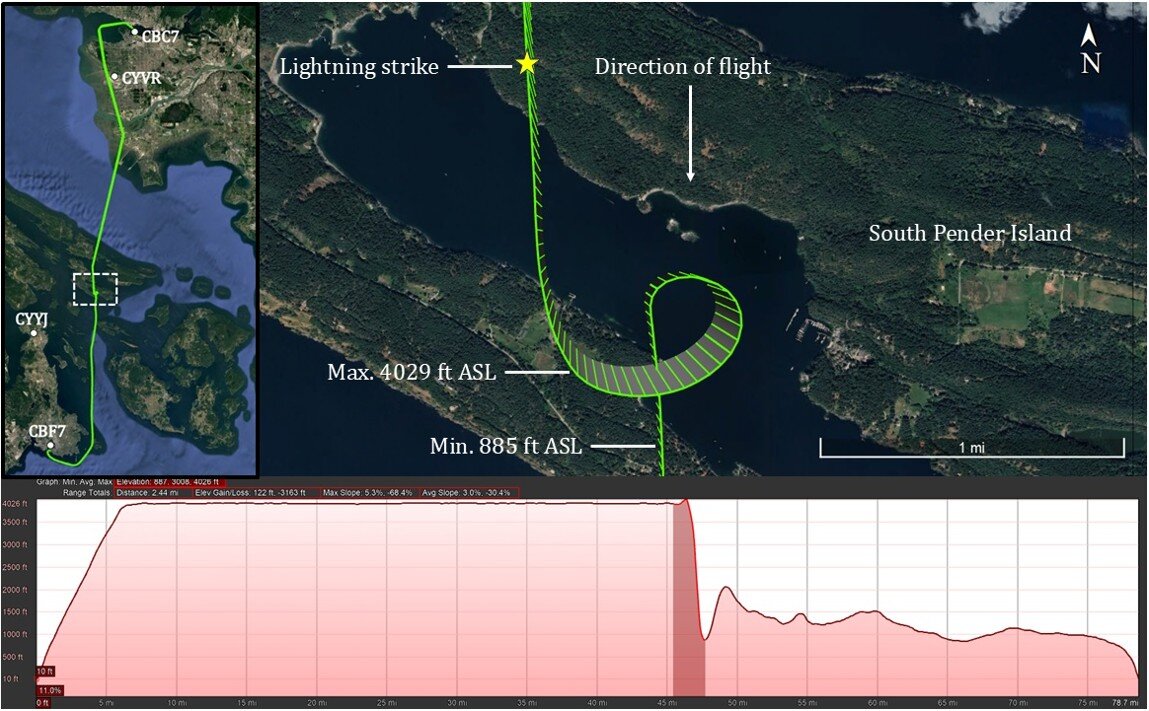
As the helicopter emerged from the clouds, the captain regained visual reference to the ground and was able to reduce the helicopter’s roll angle and stop the descent. The vertical acceleration peaked at 2.48g before the helicopter climbed back up to 2073 feet ASL.
The helicopter descended to approximately 1300 feet ASL.
The flight crew attempted to reactivate the autopilots during the rapid descent, but both autopilots were not engaged until approximately 3.5 minutes following the lightning strike after the helicopter had already regained level flight.
…the flight crew evaluated the helicopter systems in level flight and did not detect any significant defects that would preclude safe flight to the intended destination.
The helicopter landed safely at 09:44.
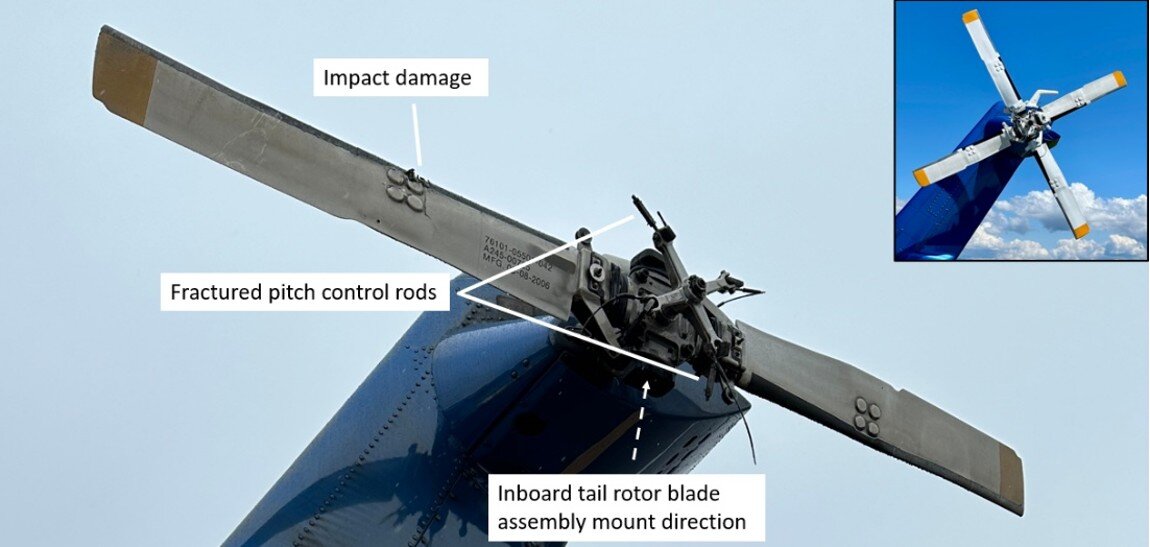
On inspection it was found that one “tail rotor blade assembly” (two blades) had separated from the helicopter, striking three main rotor blades, the left horizontal stabilizer, the left side of the tail boom, and the left engine cowl.
The…
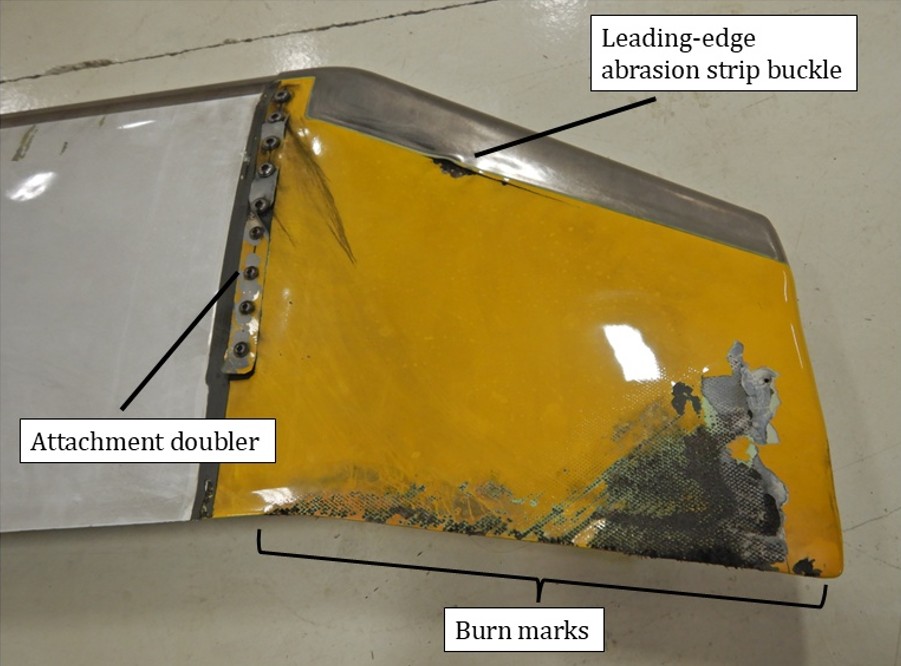
…blue main rotor blade had burn marks on both sides of the tip cap that exposed the underlying Kevlar skin. The tip cap’s leading-edge abrasion strip had buckled slightly on the upper and lower aft edge as well as on the lower aft edge at the overlapping outboard seam, which is consistent with lightning attachment. The tip cap attachment doubler had buckled on the upper and lower skins.
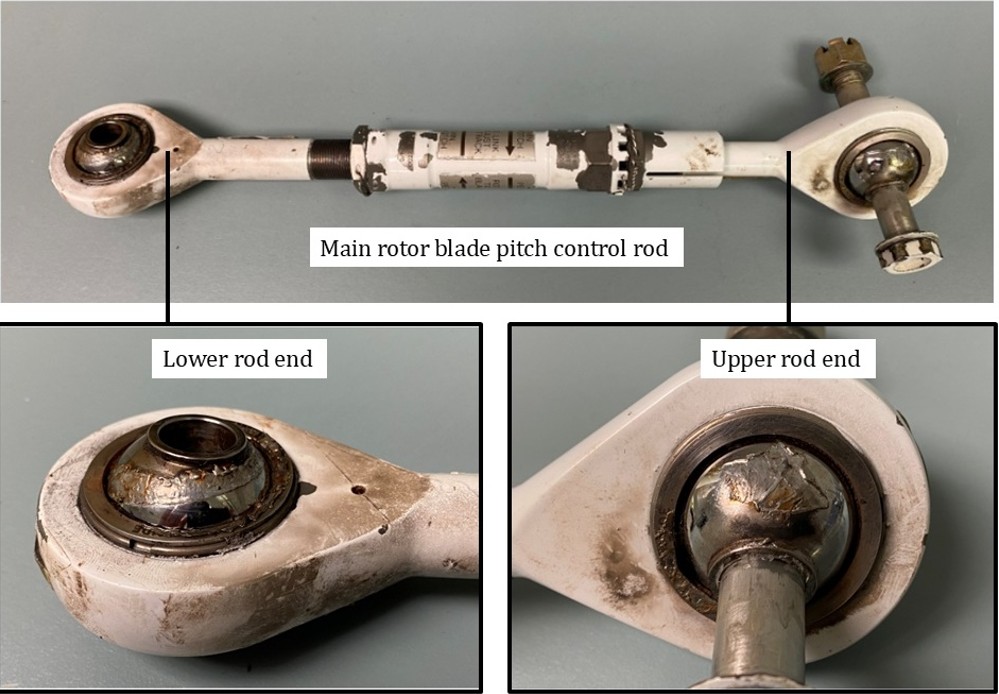
The blue main rotor blade damper, pitch control rod, and bonding jumper exhibited damage from the lightning strike. The damper inboard and outboard spherical bearings had minor pitting, flaking, and discolouration. The pitch control rod upper and lower spherical bearings and bearing races had significant discolouration with melted material over a portion of the bearing and bearing races.
TSB Safety Investigation
Helicopter-induced Lightning aka Triggered Lightning
Triggered lightning is a phenomenon in which the helicopter itself triggers a lightning strike, often in areas where there is little natural lightning activity. In flight aircraft, acquire a negative charge by the frictional contact with the air. Helicopter rotor blades generate the greatest concentration of negative charge.
When the helicopter encounters a positively charged region of a cloud and the potential difference is great enough between the opposing charges, the helicopter can trigger a positive lightning strike.
The UK Met Office has identified that such lightning strikes occur when polar air masses move over a warmer sea surface and especially when:
- Flight level static air temperature from −2 °C to −6 °C;
- Freezing level from 1000 feet to 3000 feet ASL; and
- Precipitation rates above 4 mm/h.
The temperature where the lightning strike occurred was estimated to be from −2 °C to −6 °C at 3900 feet ASL. [Radar] data indicated precipitation rates of 5 mm to 11 mm/h…at 09:30.
While accepting that the conditions were conducive of triggered lightning, the TSB claim that such conditions…
…are not readily identifiable with current weather assessment methods.
In fact the UK Met Office has been researching this subject many years (see CAA Paper 2000/02 and this 2013 presentation to the UK CAA HMRSC), leading to the implementation of triggered lightning forecasts. While it is still difficult to predict reliably, at best the TSB statement should have been clarified as “not readily identifiable with current weather assessment methods employed in Canada“.
Design for Lightning Strike Protection
The tail rotor blades…
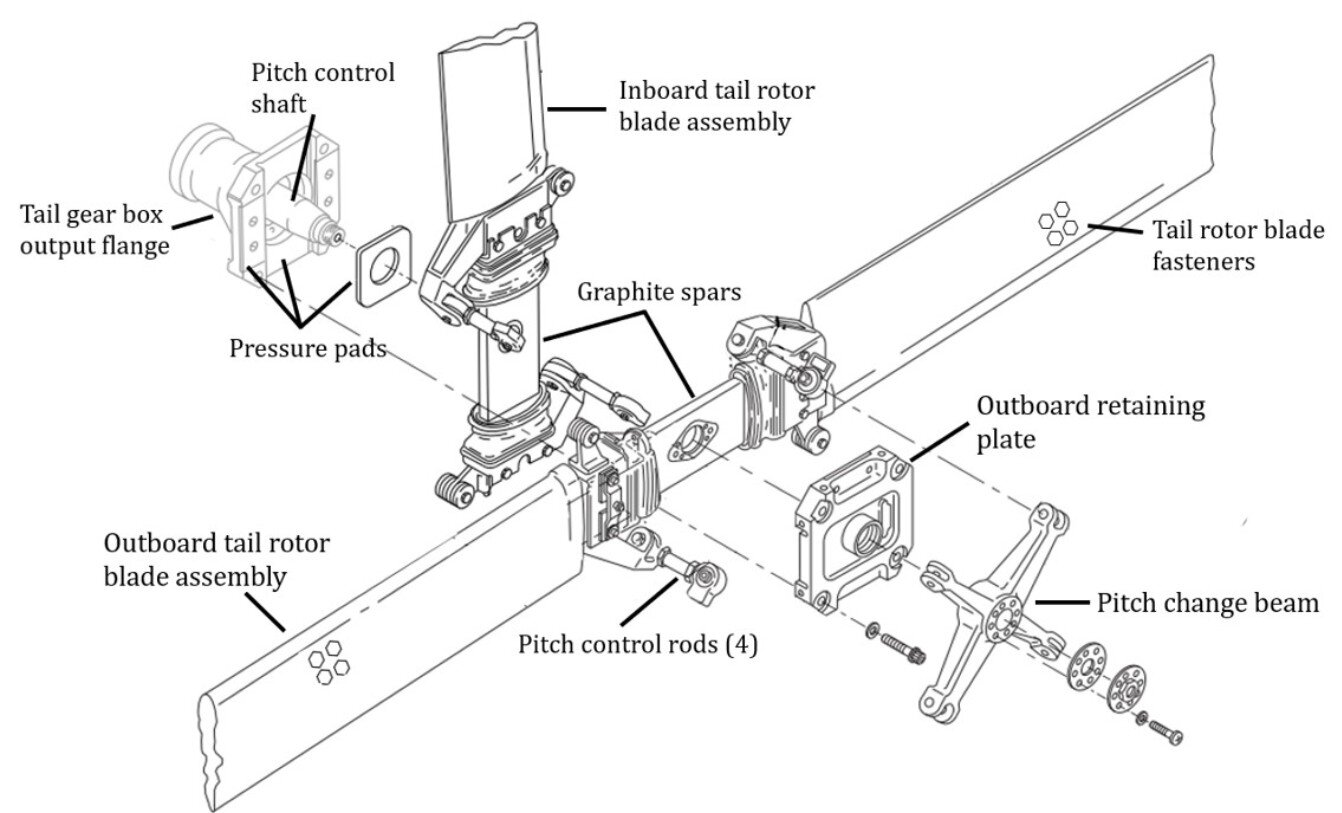
…use the aluminum wire fabric in the blade skin and tip cap to allow the lightning strike charge to transfer to the pitch horn and tail gear box output flange and onwards to the tail gear box and fuselage.
To prevent damage to the graphite spar, the fabric remains separated from the tail rotor blade fasteners that attach the spar to the blade and an insulating cover is applied over the blade fasteners.
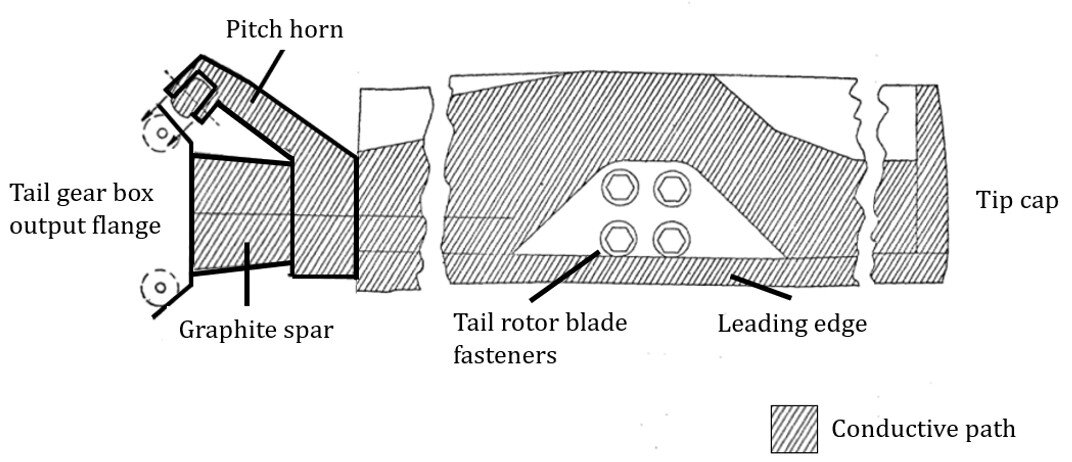
The inboard section of the spar is also protected with an aluminum wire fabric coating that transfers any flashover from the blade root to the output flange.
At the time the S-76 was designed the FAA had no requirements for lightning strike protection (those followed in 1984). Sikorsky did at their own initiative apply their own requirements. For the tail rotor they conducted lightning tests on three test articles (each “a single tail rotor blade and spar that was attached to an off-aircraft tail gear box output flange, outboard retaining plate, pitch change beam, and a pitch control rod”). They applied the 200 kA peak current amplitude specification from the US military (MIL-B-5087B) and the Society of Automotive Engineers (SAE). After that they…
…conducted static load tests and analyzed the aerodynamic effects on the blade assembly that had sustained the most damage. It was concluded that the assembly can survive a severe lightning strike and maintain operational capability.
The characteristics of the strike detected by CLDN exceeded the specification voluntarily applied during the design of the S-76.
The AFCS
The helicopter’s digital automatic flight control system [AFCS] consists of 2 independent flight control computers that each contain an autopilot and a flight director function. When turned on, the autopilot has a stability augmentation system (SAS) mode and an attitude retention (ATT) mode.
In normal operations, both autopilots are on, but only 1 flight director can operate at a time; while 1 actively steers the aircraft, the 2nd is in standby mode. Flight director operation is inhibited if only 1 autopilot is on.
According to Helijet SOPs, the flight director is normally coupled during the departure, climb, cruise, descent, and approach phases of flight, whereas the helicopter is hand flown during take off or landing, or anytime the pilot flying would prefer to hand fly.
The EFIS
The helicopter had an integrated EFIS that consisted of electronic displays including an electronic attitude director indicator (EADI) and an electronic horizontal situation indicator (EHSI).
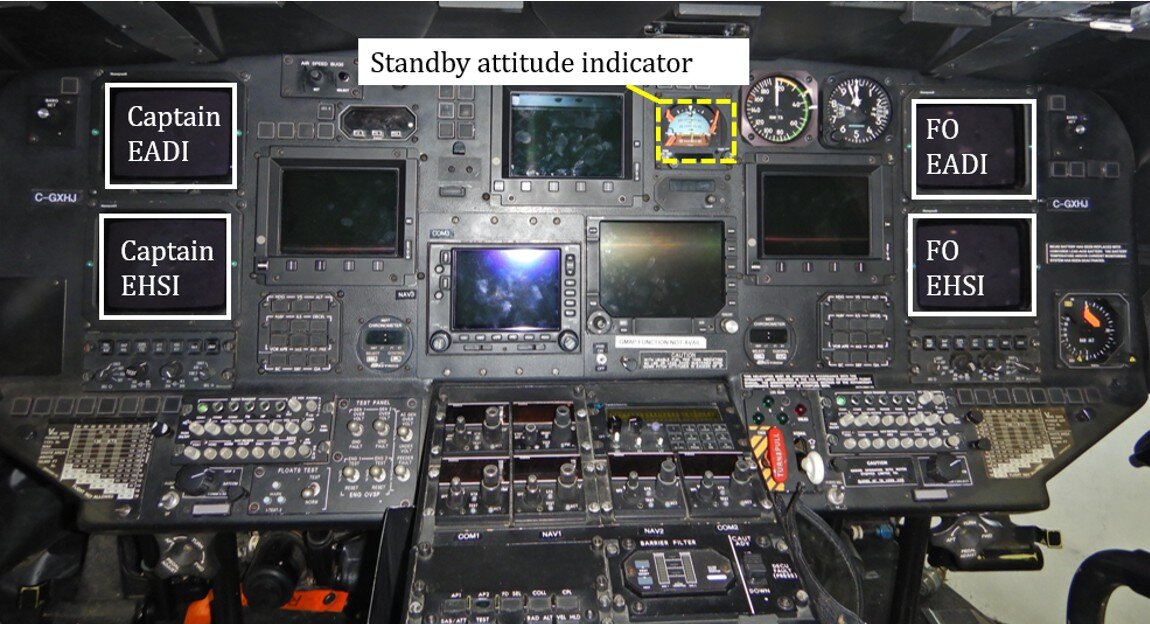
If there is a complete failure of all electronic displays, the helicopter has a standby attitude indicator, a standby airspeed indicator, a standby altimeter, and a standby magnetic compass.
The Aircraft Handling After the Lightning Strike
The sudden loss of the primary instrumentation data and AFCS while in IMC…
…resulted in a significant increase in the workload for the FO. The FO then had to manually control the helicopter, identify that most flight data was invalid…and divert his attention to the smaller standby attitude indicator…without outside visual cues.
In the 21 seconds that followed the lightning strike, the helicopter’s altitude increased, its speed decreased, its left roll increased, and its heading turned 20° to the east.
Data from the Flight Data Recorder (FDR) suggests these changes were relatively modest, apart from the roll:
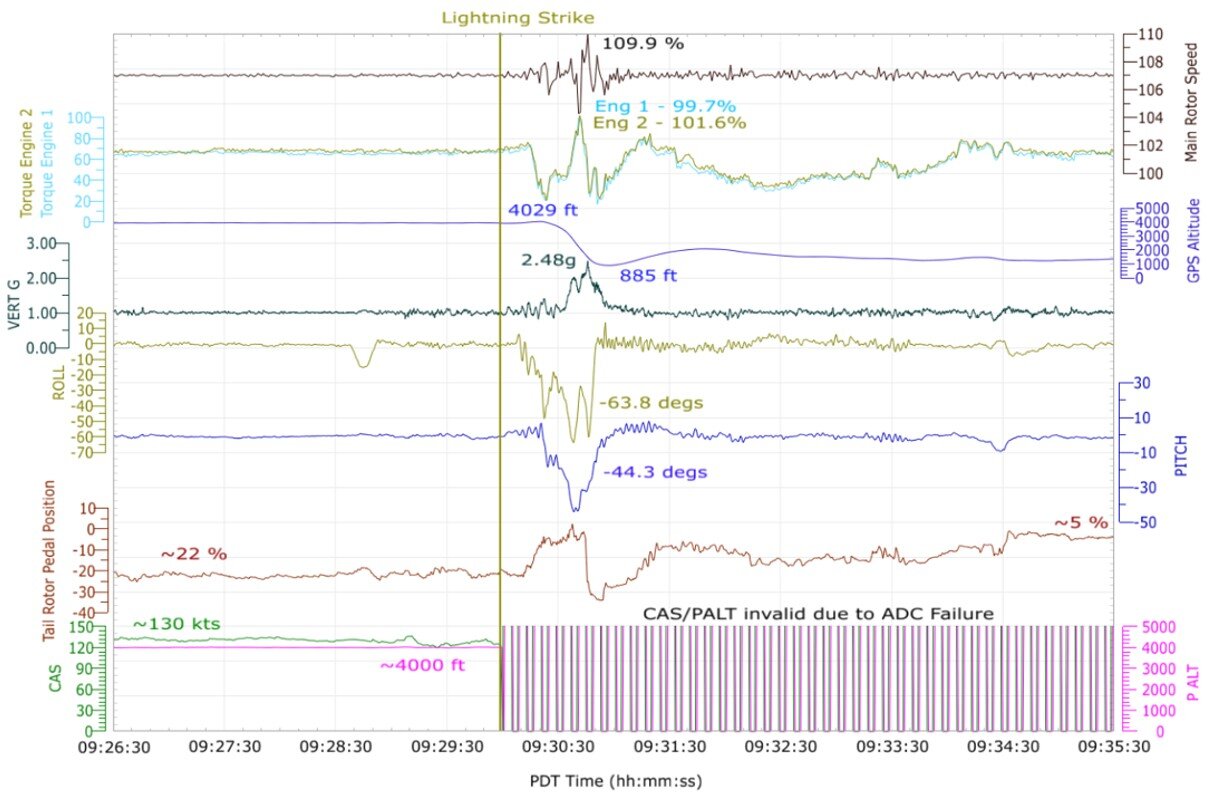
At 0930:17 the Commander took control of the helicopter. The reasoning for this is not elaborated upon. However, TSB conclude that at that point the Commander was spatially disorientated which led to a rapid loss of control – inflight (LOC-I).
The helicopter continued to turn and roll to the left before entering a rapid descent that the captain had difficulty recovering from. Even though the captain’s EFIS was back online and available during this manoeuvre, the information from the system alone was insufficient for the captain to reorient the helicopter after the turn had been initiated.
It was only once the helicopter exited the cloud and the captain regained full visual references that he was able to arrest the descent and re-establish level flight.
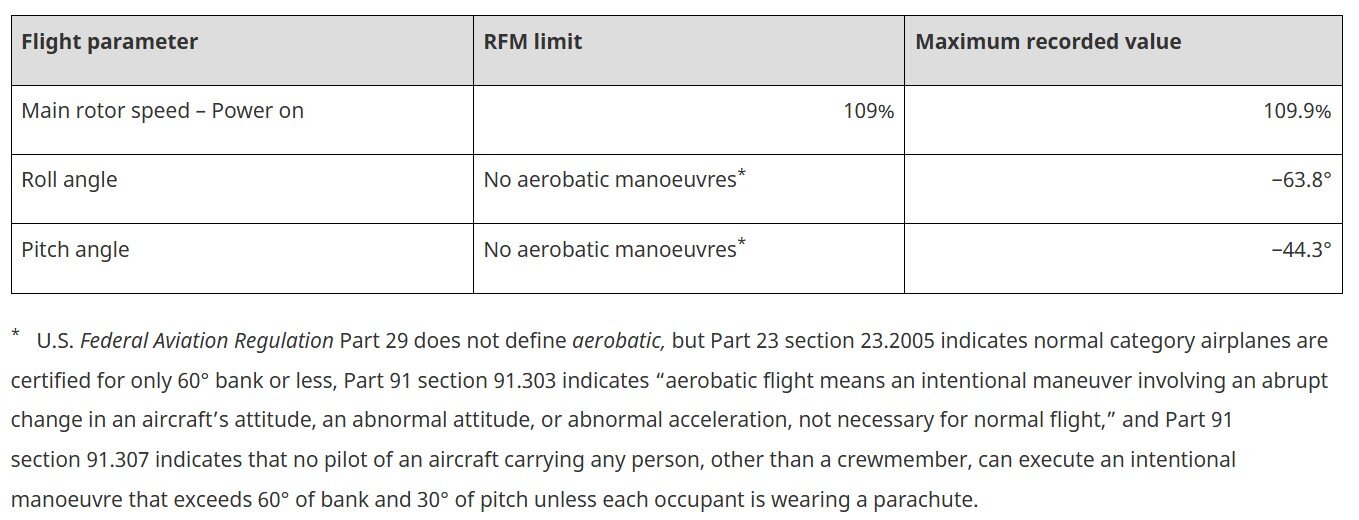
During the uncontrolled rapid descent, the recorded main rotor rpm and the pitch and roll angles momentarily exceeded the flight limitations listed in the rotorcraft flight manual (RFM).
We wait the NSIB final report into a LOC-I event involving Caverton AW139 5N-BSG while en rout to the Shell Bonga FPSO of Nigeria on 20 January 2024. In that case the loss of instrumentation was crew induced according to the NSIB preliminary report, but there was a similarly long period of LOC-I in IMC, albeit in that case cabin windows blew out.
Post-Strike Decision Making
TSB make no real assessment of the decision for the Commander to take over as PF. They extensively consider the decision on where to land however.
[After] the lightning strike and recovery from the unusual attitude, the flight crew needed to determine their next action. According to Helijet’s emergency checklist procedure for a lightning strike, which is to be carried out by memory and then verified against the checklist, the 1st action is to land as soon as possible, while still assessing for unusual or excessive vibrations.
In addition to the actions to take, the emergency checklist for a lightning strike states, in part, that, as a consideration, “[…] it is likely there will be considerable damage to main and / or tail rotor blades, rotor heads and associated components.”
The flight crew considered three options:
- Find somewhere to land or ditch the helicopter immediately
- Land at the nearest aerodrome (CYYJ)
- Continue on to the original destination (CBF7)
As the flight crew, who were not aware they had lost two tail rotor blades, felt that the helicopter was flying normally with no unusual noise or vibration they discarded teh first option.
The Commander discarded diverting to CYYJ (c 10 NM away) because…
,..the weather system the flight crew had just flown through was near the airport and he observed rain with low visibility in that direction. Conversely, the visibility along the intended flight path was unobstructed and the captain could see the south shoreline that led to CBF7 [c 21 NM away, which had a company maintenance facility].
If the flight performance deteriorated and they had to land immediately, the captain determined that, based on their altitude, the nearby shorelines of several islands and the mainland mitigated the risk for the continued flight path.
Safety Resources
The European Safety Promotion Network Rotorcraft (ESPN-R) has a helicopter safety discussion group on LinkedIn. You may also find these Aerossurance articles of interest:
- When Screens Go Blank: NTSB on a 787 Display Loss After a Lightning Strike
- Loss of Control, Twice, by Offshore Helicopter off Nova Scotia
- Fatal Offshore S-76C++ LOC-I & Water Impact Brazil 2022: CENIPA Investigation
- BFU Investigate S-76B Descending to 20ft at 40 kts En Route in Poor Visibility
- Technology Friend or Foe – Automation in Offshore Helicopter Operations
- AAIB Report on 2013 Sumburgh Helicopter Accident
- NTSB Report on Bizarre 2012 US S-76B Ditching
- Sikorsky S-92A Loss of Tail Rotor Control Events
- SAR Helicopter Loss of Control at Night: ATSB Report
- NTSB Investigation into AW139 Bahamas Night Take Off Accident
- Night Offshore Training AS365N3 Accident in India 2015
- Loss of Bell 412 off Brazil Remains Unexplained
- Dramatic Malaysian S-76C 2013 Ditching Video
- In-Flight Flying Control Failure: Indonesian Sikorsky S-76C+ PK-FUP
- Safety Lessons from a Fatal Helicopter Bird Strike: Sikorsky S-76C++ N748P, 4 January 2009
- North Sea Helicopter Struck Sea After Loss of Control on Approach During Night Shuttling (S-76A G-BHYB 1983)
- Loss of Sikorsky S-76C+ 5N-BQG of Eastwind Off Nigeria 24 October 2024
- 29 Seconds to Impact: A Fatal Night Offshore Approach in the Irish Sea
- S-76D Loss of Control on Approach to an Indian Drilling Rig
- Tail Rotor Lightning Strip Damages AW139 Main Rotor
- Helideck Lightning Strike: Damage Missed