When Screens Go Blank: NTSB on a 787 Display Loss After a Lightning Strike
13 May 2018
When Screens Go Blank: NTSB on a 787 Display Loss After a Lightning Strike
On 10 October 2014, United Airlines (UA) Boeing787-824N26906 was struck by lightning during initial climb, a few minutes into a flight from London Heathrow (LHR) to Houston (IAH). The US National Transportation Safety Board (NTSB) published their final report in April 2018.
The Incident Flight
The NTSB explain that:
The flight crew reported that the aircraft was flying through a “moderate non-CB (cumulonimbus) rain shower” with cloud tops of 10,000 feet mean sea level (msl) at the time of the lightning strike.
The strike apparently occurred just above the Captain’s forward windshield frame. It was completely unexpected. There were no precursor indications (corona, daylight visible St Elmo’s, perceived static buildup, tingling, etc.), nor were there any notable after effects other than the failures. There were no other discharges visible as we approached the cloud, or after the event.
The strike was brilliant, but not blinding; consistent with the close proximity to our eyes. The audible “crack” was very loud, as would be expected by the location, and the Flight Attendants reported hearing a rumble travel through the fuselage back to the door three area immediately after the discharge.
The NTSB say that:
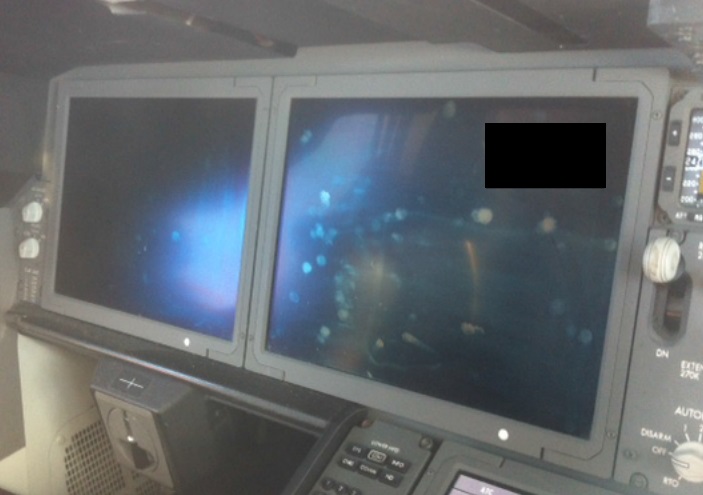
United Airlines B787-800 N26906: Captain’s side heads down display unit’s blanked during the incident (Credit: UA Flight Crew via NTSB)
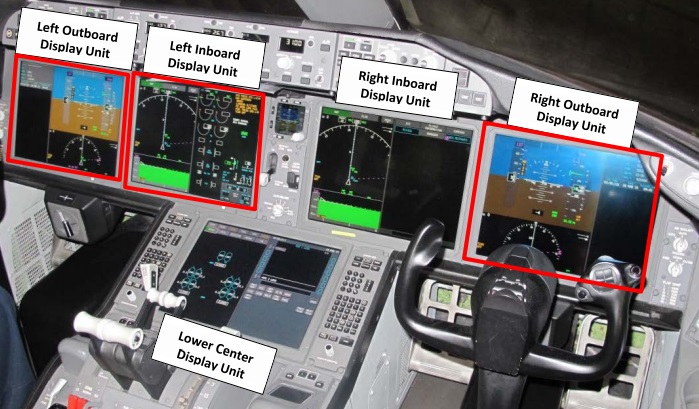
Based on crew reports and verified with images from the crew and the EAFR [enhanced airborne flight recorder], the flight crew lost the use of three of the five head down displays [HDDs] following a lightning strike.
United Airlines B787-800 N26906: Flight deck heads down display unit arrangement – those outlined in red blanked during the incident (Credit: NTSB)
[Additionally] a status message related to a power distribution channel was displayed, and the captain’s forward windshield heat became inoperative. The standby instruments and the heads up displays (HUD) were unaffected by the event.
The crew followed published procedures, however the procedures did not contain a checklist related to a partial loss of displays. After the crew elected to follow the “Loss of All Displays Checklist”, none of the affected displays recovered to an operational state.
The crew accomplished the abnormal checklist for the window heat. The checklist did not restore the function of the window heat.
The 787 cockpit has no thermal circuit breakers (TCB) accessible by the crew. A software function called Circuit Breaker Indication and Control (CBIC) provides indication and control for electronic circuit breakers (ECB) and indications only for TCB’s.
The crew made a safe landing back at LHR using the remaining two displays.
Maintenance Actions
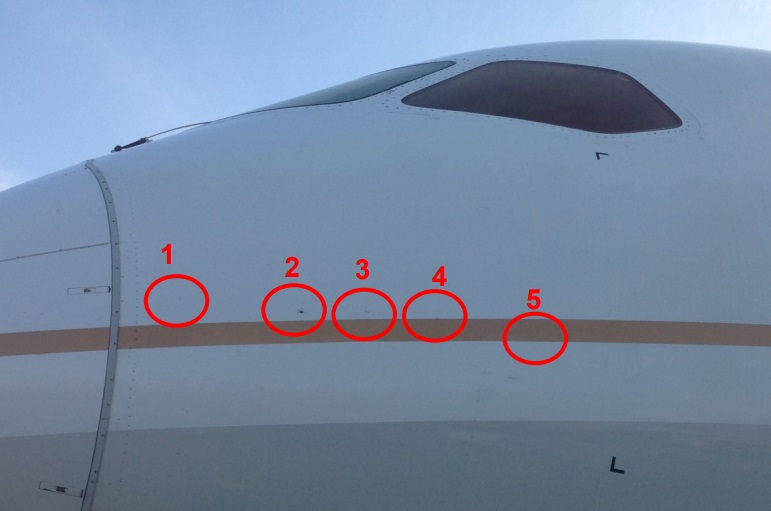
After landing, LHR maintenance performed a lightning inspection and found external nonstructural damage in five locations along the nose which was addressed in accordance with structural repair manual (SRM) allowable damage criteria.
United Airlines B787-800 N26906: Lightning Attachment Points (Credit: via NTSB)
A power reset to the aircraft per maintenance manual procedures was accomplished, and the displays and other affected systems returned to normal function.
United Airlines B787-800 N26906: Seal Damage Captain’s Windshield (Credit: via NTSB)
After a review by United maintenance personnel, the aircraft was approved for dispatch and continued the flight to IAH with no further faults noted.
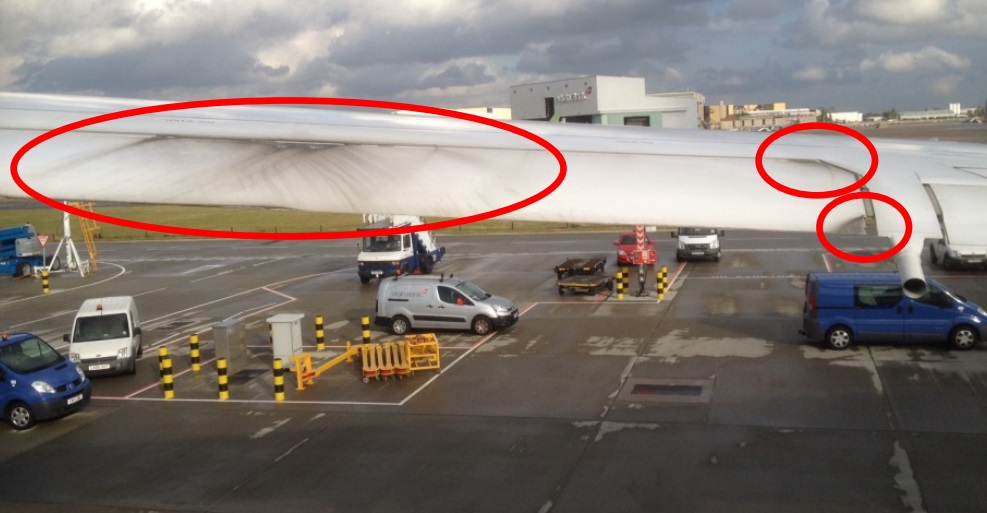
United Airlines B787-800 N26906: Possible Lightning Attachment Near Left Aileron (Credit: via NTSB)
Safety Investigation
Using data gathers during post-incident near strike lightning and flat plate testing, Boeing Company conducted an analysis of the electrical fields present in the cockpit during a lightning event:
The analysis used three current waveforms (“A”, “D” and “H”), from ARP 5412 revision B, which are the same waveforms used during certification testing and analysis of flight deck equipment.
The analysis confirmed that under some dynamic lightning conditions, the spark gap device installed in the Window Heat Protection Unit will fire. The firing of this spark gap device affected the transient electrical field characteristics. Comparing the display blanking electrical field thresholds seen during the near strike lightning and flat plate testing, the electrical field analysis results showed that, based on the lower blanking thresholds demonstrated during the near strike lightning testing and the flat plate testing, the lightning model results exceeded the lower bound estimate of the display blanking threshold during every case where a “fast” spark gap fired or a waveform “H” was applied. The upper blanking threshold was never exceeded.
The Boeing 787-8 utilizes large amounts of composites for aircraft structure. The aircraft’s structure and monocoque material is primarily conductive Carbon Fiber Reinforced Plastic (CFRP). The fuselage skins employ an (IWWF).
IWWF is a CFRP fabric into which thin bronze wires are woven near the surface of the CFRP.
The IWWF is incorporated into the fuselage skins for lightning direct effects and will not greatly affect the conductive properties of the CFRP important to lightning indirect effects.
Since the structure is primarily CFRP, the Boeing 787-8 also utilizes a current return network (CRN). The CRN was incorporated into the wings, empennage and fuselage sections to carry lightning and airplane-generated currents. With respect to lightning indirect effects, the CRN serves to minimize lightning-field coupled voltages to wiring routed in close proximity to the CRN elements.
NTSB Probable Cause
A shutdown of the displays due to the inability to operate through a rapid transient radiated electric field brought on by a near field lightning strike.
Contributing to the loss of displays for the remainder of the flight was the lack of guidance to the crew to perform a controlled power reset to the display.
Safety Action
After the event, the aircraft manufacturer notified the fleet operators of the event and subsequent loss of displays. The manufacturer has implemented a software change to the 787-10 aircraft, which will start with the first production aircraft’s entry into service (estimated 2018). The software change will automatically reset a display unit if the unit blanks due to certain internal fault conditions.
For current and retrofit 787-8 and 787-9 models, the manufacturer has evaluated an equivalent software change, based on the 787-10, and the expected implementation for the changes is in 2019.
Aerossurance is pleased to sponsor the 9th European Society of Air Safety Investigators (ESASI) Regional Seminar in Riga, Latvia 23 and 24 May 2018.
Aerossurance has extensive air safety, operations, airworthiness, human factors, aviation regulation and safety analysis experience. For practical aviation advice you can trust, contact us at: enquiries@aerossurance.com