
Legends: When HM Customs & Excise Sank the Drug Running Tug Adherence in the Bay of Biscay
There is current controversy that the US military are sinking drugs running vessels in international waters, rather than interdicting them, seizing the drugs and arresting the crew.
However, a little know fact is that 30 years ago civil servants of Her Majesty’s Customs and Excise (HMCE) sank the drug running tug Adherence and 4 tonnes of cannabis in the Bay of Biscay on 25 October 1996.
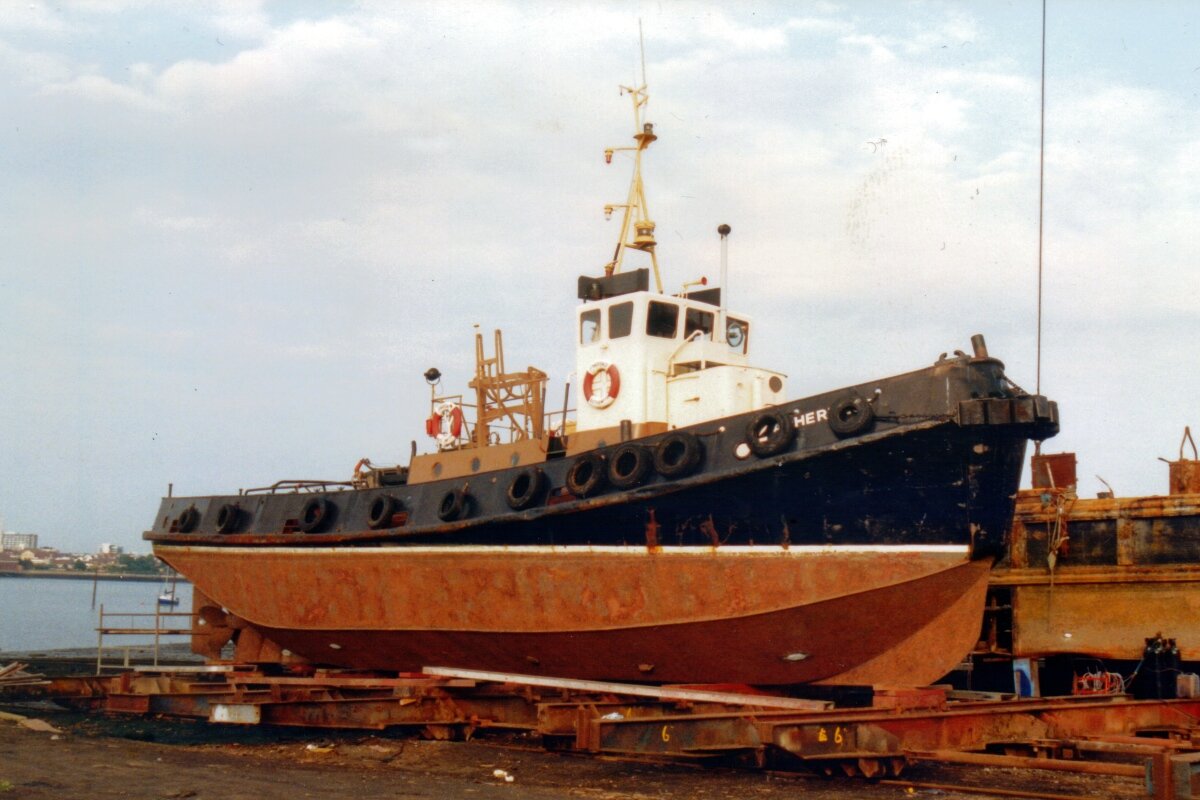
Not only that, but unlike the US military, they didn’t tell anyone. The circumstances are a little different though…HMCE were the one running the drugs! The notorious weather of the Bay of Biscay also had the casting a ‘vote’ on the survival of the Adherence.
If this sounds a bit like the Netflix TV drama Legends, released 7 May 2026, written by Neil Forsyth and starring Steve Coogan, Tom Burke & Hayley Squires, you’d be right…
Legends was based on autobiography The Betrayer: How An Undercover Unit Infiltrated The Global Drug Trade by ‘Guy Stanton’ (a former undercover customs officer), written with crime reporter Peter Walsh. Stanton discusses the loss of the Adherence in his book. While the circumstances of the real operation differ from that shown in Series 1 Episode 6 of Legends, key themes are common.
The Loss of the Adherence
The 65 ft harbour tug Adherence was built for the Ministry of War Transport in 1944 as TID 75 by Richard Dunston Ltd at Thorne, Doncaster. In 1960 it was sold by the Admiralty to commercial owners and renamed Adherence. In 1965 it was re-engined from steam to diesel prolusion.
In October 1996, lying out of commission at Husbands Shipyard, Marchwood, Southampton. one might have expected she would quietly retire after half a century of unheralded toiling.
However, she was covertly and hurriedly purchased on 18 October 1996 by HM Customs and Excise and unofficially renamed Adherence II (perhaps fittingly for how it’s undercover service turned out, a not very watertight ‘legend’!).
The tug was to be used by undercover officers from HMCE who had infiltrated a drugs gang attempting to smuggle cannabis from Morocco using the yacht Fata Morgana (named after a mirage seen at sea).
Putting to sea just 4 days after the purchase, the undercover team (two of whom Stanton describes as being on loan from an “elite MOD unit”), planned to tranship the drugs from the yacht and transport them to Cornwall in a ‘Controlled Delivery‘ in order to gather evidence to prosecute individuals across the illegal supply chain. According to Stanton this was the fourth of a series of Controlled Deliveries organised by Custom’s ‘Beta Projects’ team (the earlier three using UK based yachts operated by HMCE to tranship the drugs).
The Loss of the Adherence
On 1 December 1999 the UK Marine Accident Investigation Branch (MAIB) published a report on the sinking after they finally became aware of the incident. They coyly prefix their report with:
Many of the details about this particular incident remain confidential but are not, in
the opinion of the MAIB, germane to the causes of the foundering.
They explain that Adherence headed for a position “to the west of the main shipping route between Ushant and Cape Finisterre” for the rendezvous with the yacht.
She carried a crew of four, all undercover operatives under the operational control of the National Investigation Service, HM Customs & Excise.
On the day before the rendezvous, the crew were having trouble with the fuel supply to the engine and required additional hydraulic oil. Assistance was provided by an engineer who was flown in by helicopter from the [Type 22 Batch 3] frigate HMS Chatham.
MAIB report that:
The rendezvous with the yacht was made late on 24 October with positive contact being made early in the morning of 25 October. Once visual contact had been made, a transfer of goods by means of a floating line between the two vessels was attempted but aborted in the prevailing weather conditions.
The tug’s crew then launched an inflatable dinghy and, just before dawn, started transferring the cargo. The weather was not good and the tug’s side decks were constantly awash throughout the transfer; sometimes to a depth of 45cm.
In the hours that followed some 145 bales of cargo were transferred from the yacht to the tug and stowed in a storage locker in the after part of the vessel. Although the hatches to the locker were opened when loading the cargo, they were shut between consignments. Spray entered the locker but there are no reports of green water finding its way below.
Fuel and stores were then transferred to the yacht before the two vessels parted and the Adherence started its return to the UK.
The topography of the Bay of Biscay and its position on the eastern side of the Atlantic Ocean make it peculiarly susceptible to high seas, most especially in the vicinity of the 100 fathom contour.
The Admiralty Sailing Directions for the Bay of Biscay (NP22)….refer to the presence of depressions which can ‘very quickly develop into vigorous systems and give rise to very strong winds or gales’.
[The] wind was south-westerly force 6-7 with a commensurate sea state. It was described as ‘rough’. It was cloudy, visibility was good and there were rain showers.
In deteriorating weather conditions, and while…making about 8 knots, the tug began to ship water…[as the] waves were advancing faster than the vessel was proceeding.
It also appears that the aft peak ballast tank was also full of water. Despite running the bilge pump, it was not possible to empty the ballast tank or reduce the level of water shipped.
The bilge pump then failed, could not be restarted …
Those on board Adherence were aware of the hazardous situation developing and sought assistance from HMS Chatham at 1432, in the form of a radio request for an emergency pump.
However…
…the water ingress increased until such time that Adherence eventually foundered…at about 1530 in approximate position 47” 27’N 08” 43’W.
The crew did not use the liferafts but managed to launch a dinghy, a Zodiac Futora, that was being carried for this specific operation. One man was struck by the mast as the tug foundered but managed to make the surface where he was rescued by his colleagues. The liferafts failed to release. No EPIRB was carried.
As far as it has been possible to ascertain the first “Mayday” message was transmitted
at 1540 from a handheld portable VHF radio carried in the dinghy.Its range would have been severely limited and, depending on the height of the receiving
aerial, would have been unlikely to have exceeded 20 – 25 miles. Only vessels within this range would have been in a position to intercept it.
In order to preserve the undercover operation:
The search and rescue operation did not, unusually, feature on normal marine traffic broadcasts or schedules.
The crew was rescued by the Horncliff (Horn Line of Hamburg, Germany), at 1715.
The unnamed master of Adherence contacted his ‘owner’ via Inmarsat at 1715 and cancelled the SAR operation.
The crew were eventually transferred to the Royal Naval frigate HMS Chatham. The transfer was made at 2130. They eventually returned to the United Kingdom.
The involvement twice of HMS Chatham, which “had remained in the area throughout”, indicates the close liaison between HMCE and the Royal Navy.
Safety Investigation Challenges
Slightly sniffily MAIB comment:
Accidents involving UK vessels are required to be reported to the Marine Accident Investigation Branch in accordance with the Accident Reporting and Investigation Regulations 1994. This incident was not.
They note that due to the circumstances that the vessel was acquired in, there was…
…confusion over the transfer of ownership that eventually led to misunderstandings about who was responsible for reporting that an accident had occurred.
Furthermore the judge in the subsequent drugs smuggling trial had ordered that “there should be no disclosures on ownership of the tug”, meaning the MAIB did not probe that matter.
Its highly likely the legal owner was an HMCE front company being run by undercover officers
MAIB were also, perhaps unsurprisingly, unable to find out much about the undercover crew and were only prepared to describe them as “UK government employees”.
The inquiry had no grounds for believing the crew were other than competent, although probably not holding the required certificates, but there was clearly a conflict between operational imperatives and the safety of personnel and the seaworthiness of the vessel being used.
At least one of the crew appeared to have extensive experience in sailing vessels. His qualifications or experience in power driven vessels is unknown.
The MAIB did accept that:
This particular incident was unusual in that much of the evidence was confidential and that some of the actions taken reflected a need by HM Customs and Excise’s National Investigation Service to protect its operating methods and sources.
NIS had then recently been formed when the Investigations Division (ID) had absorbed the Investigations Units (IUs) of the ‘Collections’, each local area HMCE office. Despite the impression given by the TV drama legends, the work of ID has been detailed in teh 1987 BBC documentary series The Duty Men and the book of the same name.
MAIB Analysis
There is nothing in the evidence to suggest that Adherence was unseaworthy for the operation. While capable of operating on the high seas, she was primarily a harbour or estuary tug and her low freeboard made her an unsuitable vessel for this type of operation in the notoriously rough seas of the Bay of Biscay in October.
Any undercover operation involves taking risks, often substantial ones. These have to be balanced against sensible precautions to ensure that those involved are not put to unnecessary risk. Had, for instance, one or more of the crew lost their lives when Adherence sank, searching questions would have been asked and the future of similar operations might have been placed in jeopardy. All four crew survived and this, in itself, does them credit but the lessons must not be ignored.
On the circumstances leading up to the loss:
During the passage to the rendezvous, the tug was subjected to a severe battering by the rough seas and was rolling some 20° either way. This would have been very tiring for the crew.
On the morning of the transfer, the four man crew started work very early. Throughout the transfer they became very wet and extremely tired.
Under these conditions, even the fittest, most experienced and dedicated seamen would have been hard pressed to cope with a steadily deteriorating situation.
The decision to load the entire [3-4 tonne] cargo aft contributed to the ease with which water accumulated in the after part of the vessel
[It] is likely that the extent of the flooding in the early stages was not noticed…
At least some of the water entered through the engine room vents and the aft locker hatch. Once her stern had submerged, the rest of the vessel filled rapidly through various openings.
After the Sinking
Cannabis seized elsewhere and being held in a Queen’s Warehouse was put in sacks to look as if it had been transferred from the Fata Morgana so the controlled delivery could continue. The drugs were landed in Cornwall by RIB. Arrests were made in the UK as the drugs were collected on the beach and after the yacht was intercepted by the Royal Navy. The ring leader was sentenced to 14 years at Exeter Crown Court. Four others received 8-10 years.
HMCE was ultimately split:
- The main border protections functions merging with immigration service into what is today Border Force
- The more financial functions (including administering VAT) merging into HM Revenue & Customs
- NIS merged with a number of police units into what is today the National Crime Agency