
Professionalism and Integrity in Aviation
The UK CAA discusses Professionalism and Integrity in Chapter 9 of CAP716 (Aviation Maintenance Human Factors). They write (our emphasis added)…
…what is most important is to emphasise the combined responsibility of the organisation, its management and supervisors, its processes and procedures, as well as the individual responsibility of each employee…towards safety.
Elsewhere in CAP716 they defined “professionalism” as:
Inspiring confidence in others of one’s capabilities and soundness of judgement.
They illustrate this by identifying five characteristics of professionalism that are universally relavent:
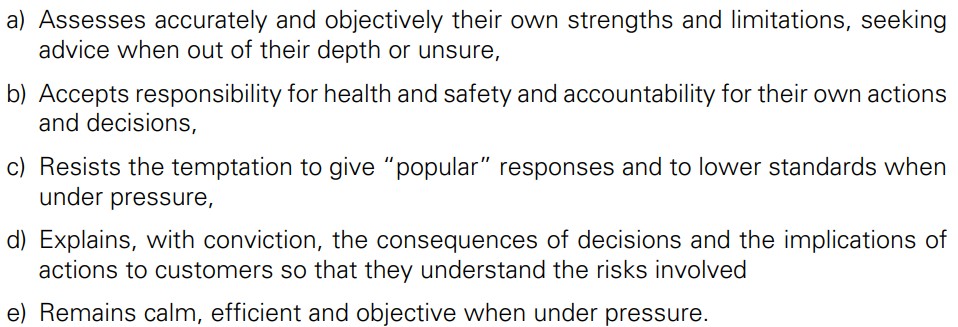
However, they also warn that in practice:
Everyone has their own idea of what constitutes “professional” behaviour.
CAP716 therefore recommends setting standards for and providing staff “mechanisms and support to enable them to work professionally” (emphasising again the organisational contribution).
They provide some examples of professionalism, good and bad :
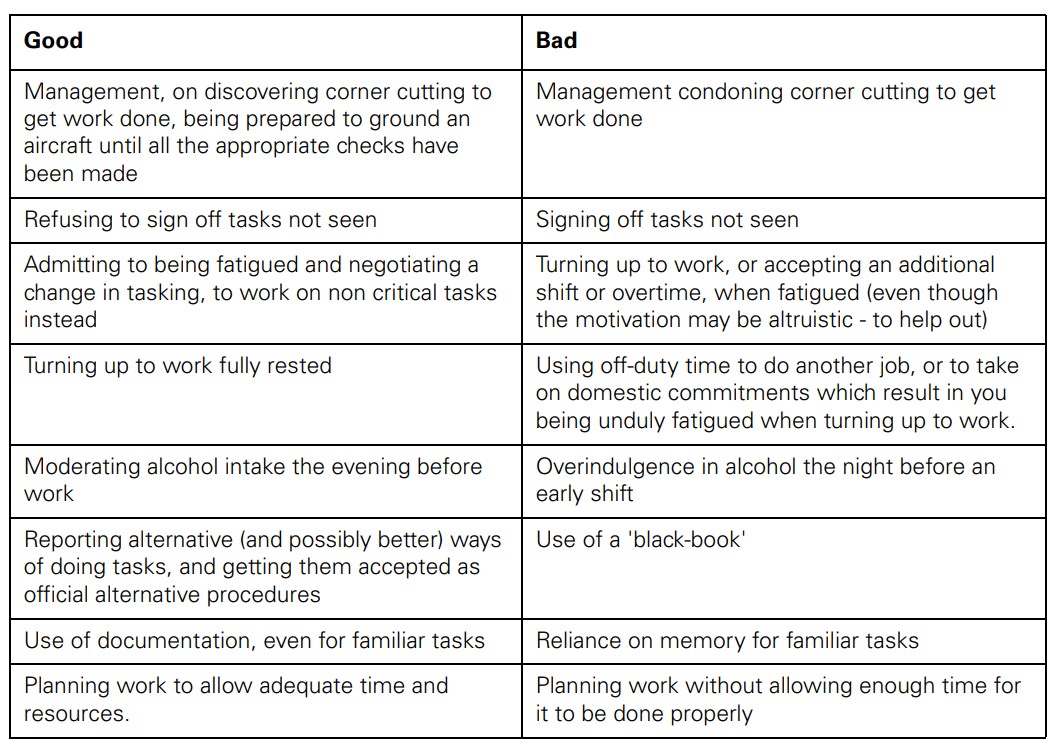
Most of these examples are relavent beyond the hangar floor and beyond maintenance too.
Of note is that the UK CAA didn’t feel in 2003 they could advocate abstinence from alcohol on a work night, merely moderating drinking!
Challenges
Echoing their earlier comment on “combined responsibility” they warn that “organisational problems (e.g. poor procedures, commercial pressures, unavailability of correct tooling, poor training, etc)” can put individuals in a position “they are prevented from behaving as they would wish”.
This is a significant warning as when things go wrong its too easy to focus on determine the possible culpability of frontline personnel while minimising attention on rectifying systemic organisational problems and their causes.
However, elsewhere in CAP716 it is stated that:
An unpremeditated or inadvertent lapse should not incur any punitive action, but a breach of professionalism may do so.
It is suggested that one circumstance where disciplinary measures might be justified is when there was “substantial deviation from the degree of care, judgement and responsibility reasonably expected”.
We would observe there are two issues which make this very difficult to assess:
- It is challenging to determine this consistently if, as UK CAA warn, there is a diverse understanding within an organisation of what constitutes professional behaviour. UK Employment Tribunals, for example, have disagreed over conclusions of aviation industry “event / just culture review groups” and disciplinary hearings on this very point.
- Being the victim of commercial pressure or inadequate training, equipment and training can also be too easily misconstrued as a “substantial deviation” for not resisting what is evident with the benefit of hindsight. This is especially the case in pathological organisations who prefer to pin responsibility on frontline staff.
On the matter of hindsight, the public inquiry into the 1988 Clapham Junction rail accident chaired by Anthony Hidden QC, known as the Hidden Report, commented:
There is almost no human action or decision that cannot be made to look flawed and less sensible in the misleading light of hindsight. It is essential that the critic should keep himself constantly aware of that fact.
Training
CAP716 discusses the topic of professionalism in aviation maintenance in the context of major maintenance human factors (HF) related regulatory changes introduced in Europe in 2003. The larger of these changes related to HF training requirements, so perhaps it is not surprising that training was seen as a default solution to many issues in CAP716.
UK CAA recommend that for human factors training that the trainer (or facilitator) should “determine whether any problems which might exist are with the lack of professionalism of individuals, or more systemic issues, and to ‘pitch’ the training accordingly”. How that might be done is not discussed.
One obvious source of such insight is safety reporting and associated investigations. While these may identify some relavent issues they will only help where the focus was on identifying the systemic issues and their causes. A proactive observation programme (such as LOSA or MOP [see below]) should add insight. Another might be workforce safety surveys, but again the underlying systemic issues need to have been studied.
No matter what method is used, buying in un-tailored training from third party providers increases the risk of the ‘pitch’ missing the target.
Leadership
We would suggest that more valuable than training is ‘leadership’ (used as verb to mean the activity, not as a pseudonym for senior managers). This is a powerful means to influence organisational culture and in turn what is mutually considered professional behaviour at all levels across organisations. We highly recommend this case study: ‘Beyond SMS’ by Andy Evans (our founder) & John Parker, Flight Safety Foundation, AeroSafety World, May 2008.
Where an organisation’s managers exhibit poor levels integrity & professionalism it should be no surprise if their employees sometimes lapse to the low bar being set.
UK CAA CAP716: Aviation Maintenance Human Factors
CAP716 remains a valuable source of maintenance human factors information but its disappointing that it lacks an update to incorporate a generation of actually applying human factors in maintenance.
Safety Resources
You may also find these Aerossurance articles of interest:
What Lies Beneath: The Scope of Safety Investigations
James Reason’s 12 Principles of Error Management
Psychology of Blame
Airworthiness Matters: Next Generation Maintenance Human Factors
Aircraft Maintenance: Going for Gold?
B1900D Emergency Landing: Maintenance Standards & Practices
CHC Sikorsky S-92A Seat Slide Surprise(s)
The Power of Safety Leadership: Paul O’Neill, Safety and Alcoa
Leadership and Trust
Maintenance Observation Programme (MOP)
Aerossurance worked with the Flight Safety Foundation (FSF) to create a Maintenance Observation Program (MOP) requirement for their contractible BARSOHO offshore helicopter Safety Performance Requirements to help learning about routine maintenance and then to initiate safety improvements. MOP was subsequently adopted by IOGP in their Recommended Practices.