
Fatal USCG SAR Sikorsky MH-60T Jayhawk Break (CG6063 off Oregon)
On 27 February 2026, US Coast Guard (USCG) Sikorsky MH-60T Jayhawk CG6063, based at Astoria, Oregon, suffered a hoist cable / radar mast contact, cable break and fatal fall of a rescue swimmer.
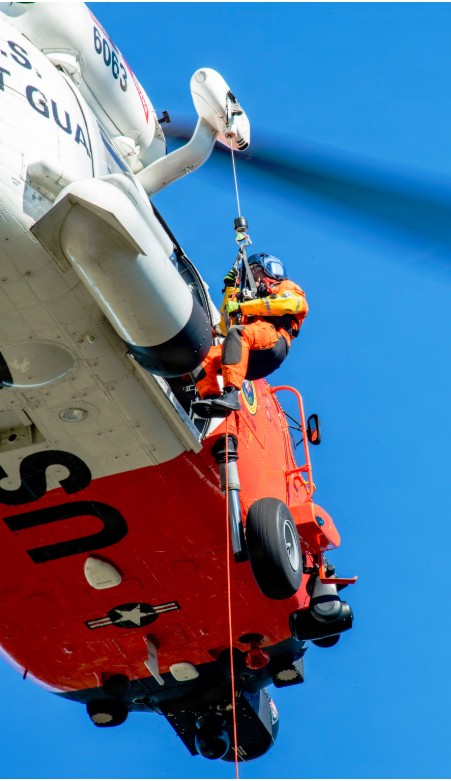
The USCG issued their Major Incident Investigation (MII) report on 16 October 2026.
The Accident Flight
The helicopter was tasked to conduct a medical evacuation (MEDEVAC) from a 190 m long Panamanian geared Supramax bulk carrier, the MV MOMI ARROW, c 96 NM west of Cape Flattery, Washington.

A MOMI ARROW crew member was suffering a suspected stroke. Royal Canadian Air Force (RCAF) Airbus CC-295, callsign KING FISHER 503, from CFB Comox, British Columbia, was also assigned to support the tasking.
The aircraft commander had 2111 total hours (460 on type, formerly a USCG MH-65 pilot), the co-pilot 1886 (483 on type and formerly a US Army AH-64 pilot), the hoist operator (‘flight mechanic’) 1837 hours (almost all on type( and the rescue swimmer had 311 hours (almost all on type). All 4 crew had been with the ‘parent command’ for 20-27 months.
The timeline in the MII report is made difficult to follow by being split between two sections in the report (‘Overview of Flight, Hoist and Response’ and ‘Risk Management’). We consolidate them here for ease of comprehension.
Before departure the crew conducted a ‘risk-management brief’, scoring the flight as ‘low risk, high gain’.
At 10:16, CG6063 departed Astoria and transited northwest at c 1000 ft and 125 knots to the rendezvous with the vessel.

At 11:25:11, KING FISHER 503 has established communications with the ship, conducting a vessel brief and communicating that the hoist location would be the 19.92 m long x 25.80 m wide cargo hatch no 5, just forwarded of the vessel’s superstructure. This was marked with a yellow 5 m diameter circle marked ‘Winch Only’. Being a geared bulk carrier a crane was positioned between the no 4 and no 5 hatches. This location apparently has been selected by USCG Joint Rescue Command Center (JRCC) – Seattle staff based on satphone discussion with the vessel.
KING FISHER 503 had requested the vessel hold a course of 250, later updated to 280, and slow to bare steerageway (minimum speed a vessel needs to maintain its direction and control). The course was selected based on guidance from the helicopter crew while en route.
En route to the helicopter crew had reviewed pictures of the vessel and independently decided that the bridgewing would be a “fine” hoisting location, according to the aircraft commander. The helicopter crew commenced a hoist brief. It was interrupted 4 times by radio calls (including it seems being notified of the agreement to host from the hatch cover) and so took c 13 minutes.
The crew discussed fouled cable and cable shear procedures according to the investigators. However, the crew did not discuss abort hoist procedures, hoist failures or the risks associated with the hoist altitude. The investigators state that the crew…
…did not complete a thorough hazard analysis or risk assessment. The [helicopter crew] did not discuss potential alternative hoist locations, the effects of the wind and seas on the vessel or identify hazards through a risk-management process.
At 11:37:34, the aircraft commander “updated the hoist brief and reviewed visual references and altitude”. The investigators note that the crew “verbalized the vessel’s bridge and cranes as hazards but did not identify the radar mast as hazardous” nor other radio antenna.
At 11:43:10 CG6063 arrived on scene, then completing a right-hand orbit of the vessel and entering a 200 ft hover off its starboard side.
At 11:47:17 the helicopter requested the vessel alter its course to starboard and maintain a heading of 030 degrees true at slow speed. The request was to improve visual references for the Pilot Flying while pointing into wind. This new course “placed the vessel beam-to the seas, causing significant roll motion”.
During the overhead check, the CG6063’s radar altimeter indicated a hoist altitude of 150 feet, giving 20-30 ft of vertical clearance. Sea state was c 2.5 – 3 m.
At 11:54:19 the rescue swimmer was in the doorway.
At 11:54:35 the hoist operator “assumed responsibility for hazard and obstacles clearance on the right side and underneath the aircraft”.
At 11:56:10 CG6063 commenced hoisting down the rescue swimmer. The aircraft heading was 290 degrees magnetic while the ship was on a heading of 14 degrees magnetic with the winds from 266 degrees magnetic.
They chose not to deploy a hi-line (referred to by the investigators as a trail-line). This was apparently because they were aware the vessel’s crew had been asked not to assist the rescue swimmer (presumably for fear of injury) and because they doubted the crew would know how to use a hi-line.
At 11:56:31 the hoist operator paused the hoist due to the vessel’s roll of the vessel and the rescue swimmer immediately developed a “swing”, while c 70 ft (~1.5 rotor diameters) below the helicopter. The hoisting resumed and the swing continued to increase, uncorrected. Hoist camera footage showed the swing reached an amplitude of c 27 m. The swing was “offset from the CG6063 heading, from the 11 o’clock position to the 5 o’clock position underneath the aircraft”.
At 11:57:19 the hoist operator made the decision to abort the hoist. At 11:57:25, the co-pilot, who was monitoring the hoist via the hoist camera display at the time, suggested flying ‘forward’ first so as to not make the swing worse (necessitating overflight of the superstructure). At 11:57:35, CG6063 had moved forward and left (relative to its orientation), over the starboard superstructure of the vessel.
At 11:57:35, during a further swing, the hoist cable contacted the vessel’s radar mast and broke. The rescue swimmer fell (c 30 ft vertically and c 30 feet laterally due the swing) and impacted the port railing on the vessel’s C Deck (the deck below the bridge).
The ship’s crew immediately gave first aid to the rescue swimmer who was “unconscious but breathing” but suffering multiple factures.
The helicopter crew conducted a quick-splice to add a hook to the remaining hoist cable. Then c 54 minutes later CG6063 recovered the rescue swimmer. They took them Victoria General Hospitall, Victoria, British Columbia. On 5 March 2026, the rescue swimmer sadly succumbed to their
injuries. The cause of death was determined as “Blunt Force Injury to the Head due to a Fall from Height”.
The USCG Safety Investigation
No pre-impact issues were found with the helicopter and its equipment.
The engineering analysis established the mode of failure of the hoist cable as instantaneous shear cutting of wires. The material evidence shows that the hoist cable came in contact against a relatively sharp edge with a sufficient transverse force to plastically deform and cut the hoist cable
The [tested] breaking strength of the hoist cable exceeded the minimum 3,330 pounds requirement and the wire alloy was in conformance to the elemental chemistry requirements of 304 stainless steel.
The force exerted on the cable tension was approximately 4,000 pounds at the moment just after striking the ship’s mast. At the same time, a normal force of approximately 6,300 pounds was also acting on the cable due to contact with the ship’s mast. The hoist cable
sheared 7.5 inches above the hoist hook.The remaining hoist cable was analyzed and found to have no corrosion, fatigue, severe wear, welds, high heat exposure, or broken wires.
The investigators used the Department of Defense Human Factors Analysis and Classification System (e.g. see the USAF DoD HFACS Guide) to analyse the accident. The HFACS framework is divided into four categories: Acts, Preconditions, Supervision/Leadership, and Organizational Influences. Each category is then subdivided into groups of human factors and finally specific human factors classifications.
The USCG Convening Authority concluded that the contributory factors were:
(1) HFACS AE 201 Inadequate Real-Time Risk Assessment/Action: [The crew] proceeded with the wrong course of action based on an ineffective real-time assessment of immediate hazards during execution of a mission, which resulted in the mishap. Due to the relative motion of the ship, the superstructure and radar mast posed immediate hazards to the hoist and were not adequately identified or discussed as hazards. During the hoist, a combination of aircraft movement and the effects of the rotor wash, immediately created a swing of the [rescue swimmer]. When the decision to abort was finally made, the [co-pilot] recommended flying forward to stop the swing. While technically correct in some contexts, this was the wrong action due to the [crew]’s loss of situational awareness (proximity to the hazards) and failure in real-time risk management. As the aircraft transitioned forward, it failed to maintain lateral separation from the vessel. The aircraft flew directly over the superstructure, putting the [rescue swimmer] in immediate danger of impacting the vessel.
(2) HFACS AE 104 Under-controlled Aircraft and Hoist System: [The crew] failed to maintain a stable hover position over the insertion point, failed to maintain proper cable management during the hoist, and failed to safely control the aircraft during the abort maneuver; these are all actions that substantially contributed to the mishap. After completing the overhead check, the aircraft drifted aft and left, moving away from the briefed insertion point. The [hoist operator] provided conning commands to correct the position; however, the [aircraft commander] did not apply the necessary inputs to return the aircraft to the designated location. The high hoist altitude and the choice of visual references limited the [aircraft commander’s] recognition of the aircraft’s positional change. Concurrently, the [hoist operator] became fixated on the swing of the hoist and stopped providing regular conning commands regarding the aircraft’s position. During the hoist abort, the [hoist operator] failed to properly control the cable, attempting to hoist the [rescue swimmer] up rather than maneuvering…away from immediate hazards. During the abort…the aircraft transitioned forward directly over the starboard bridge wing, navigational bridge, and radar mast. This maneuvering, combined with the magnitude of the cable swing, resulted in the rescue hoist cable contacting the vessel’s radar mast.
(3) HFACS PC 101 Inattention: [The crew] did not achieve or maintain a high state of readiness regarding the hazards presented during the hoist, substantially contributing to an inadequate real-time risk assessment and the mishap. The environmental conditions, size of the vessel, dimensions of the hoist location, fuel reserves, and the power available were all favorable for the mission and created a scenario where the risks and hazards present were not adequately assessed. Prior to the mishap, the [crew] exhibited a shared mental model that the medevac would be a straightforward mission and expressed no concerns. The minimal discussion and depth of analysis during the brief, combined with the failure to assign specific pilot monitoring duties, indicate that the [crew] did not approach the hoist with the warranted level of attention.
(4) HFACS PC 102 Fixation (Channelized Attention): [The crew] became fixated on the swing…resulting in a loss of situational awareness and failure to safely maneuver the aircraft. The [hoist operator’s] fixation was demonstrated by attempts to control the swing, increasing levels of concern on the magnitude of the swing, large periods of silence, and the delay to the abort decision. The [aircraft commander] was exclusively focused on the progress of the hoist, the decision to abort the hoist, and was unaware of the aircraft’s change in position. The [co-pilot] demonstrated fixation through the failure to verbalize proximity to hazards and failure ensure the safe flight path of the aircraft during the abort maneuvering.
(5) HFACS PP101 Ineffective Team Resource Management (Crew): [The crew] failed to actively maintain an accurate and shared understanding of the evolving task, substantially contributing to the over control and under control of the aircraft and the mishap. During the on-scene review of the Hoist Brief, the [crew] did not discuss the risks and hazards associated with high hoists, risks/hazards associated with hoisting from deep draft vessels, risks and hazards associated with hoisting amidships, nor did the [crew] discuss abort actions. The [aircraft commander] did not task the [co-pilot] to provide any specific information during the hoist. Throughout the hoist evolution, a lack of effective communication resulted in the [crew] not having a shared understanding of the aircraft’s position nor the magnitude of the swing.
(6) HFACS AE 105 Breakdown in Visual Scan: [The crew] experienced a breakdown in visual scan; and that these breakdowns substantially contributed to both over-control and under-control of the aircraft and hoist cable. Prior to the mishap, the aircraft established a hover off the starboard side of the vessel [which] allowed the [aircraft commander] to maintain visual references with the vessel’s deck cranes and the vessel’s bow; however, the high hoist altitude restricted [crew] visibility of the hoisting location, and the orientation placed [such that] both the [aircraft commander and hoist operator] were facing away from the vessel’s superstructure and radar mast, which given the ship’s forward motion, represented the most immediate hazards. The [aircraft commander’s] visual scan failed to detect the aircraft’s aft and leftward drift. Although positioned closest to the superstructure and radar mast, the [co-pilot] failed to identify the narrowing field of view of the superstructure…a critical indicator of the leftward drift. Furthermore, the [co-pilot] did not effectively monitor the hoist camera’s video display, missing clear visual cues regarding both the…drift and the…swing. During the abort, the [co-pilot’s] visual scan broke down, and they failed to recognize the loss of separation from obstacles and hazards. …task fixation caused a critical breakdown in the [hoist operator’s] visual scan, ultimately resulting in a failure to recognize the proximity…to the vessel and the forward motion…toward the radar mast…
Our Safety Observations
No safety actions are recorded and no safety recommendations are made in the MII report. This publicly released report is likely accompanied by a confidential safety investigation. As noted above its layout poor.
While the use of HFACS adds structure to the analysis it also seems to have helped constrain the investigation to the acts and omissions of frontline personnel, with all 6 HFACS items coded being at the first level. There is no consideration of procedures, training, equipment, supervisory and organisational matters in this case. For example:
- Though critical of supposed crew complacency, the USCG’s own pre-flight risk assessment concluded this was a low risk flight! Yet again this accident demonstrates that accidents still occur when low risk scores are calculated using simplistic and uncalibrated proforma checklists.
- The rescue swimmer does not appear to have had radio communication with the rest of the crew, something that is perfectly practical during such a tasking and common with other SAR operators. If they had voice comms there would have been extra shared awareness and challenge.
- The investigators make no comment of the co-pilot, the pilot monitoring, being seemingly focused on the hoist camera (particularly at the time the suggested forward movement i.e. over the superstructure. Arguably they would have more value monitoring obstacles and instruments than watching a camera display of the scene the hoist operator is already focused on.
The main thrust in the report is that ‘errors were made’, though its a fundamental feature of human performance is that errors WILL occur, but there is little consideration of why the crew’s decisions made sense to them at the time.
There is a touching confidence that more discussion of risks and verbalisation of specific obstacles would have resulted in better obstacle avoidance. Its seems inconceivable that when the crew noted the bridge as an obstacle that they did not automatically consider obstacles above it (masts, antenna, funnel, etc). The configuration of this bulk carrier is entirely conventional and a main mast was not an unusual or surprising feature. We’d consider obstacle identification and avoidance is an inherent part of such a tasking and normal crew duties. However, crucially, the investigators do sensibly highlight the lack abort brief for the specific hoisting scenario being undertaken.
Three areas with high potential for preventing similar accidents are the relative positioning of vessel & helicopter, the duties of the pilot monitoring and plan of what to do when aborting.
Safety Resources
On human factors & error management you might find these articles of interest:
…and our review of The Field Guide to Understanding Human Error by Sidney Dekker presented to the Royal Aeronautical Society (RAeS): The Field Guide to Understanding Human Error – A Review
The European Safety Promotion Network Rotorcraft (ESPN-R) has a helicopter safety discussion group on LinkedIn and a Hoist Operation Safety Promotion LinkedIn group.
You may also find these Aerossurance articles of interest:
Two Rescuers Fell When Hoist Cable Damaged After a Loss of Hover Reference
Fatal USCG SAR Training Flight: Inadvertent IMC
SAR Hoist Cable Snag and Facture, Followed By Release of an Unserviceable Aircraft
Fatal Fall From B429 During Helicopter Hoist Training
SAR Crew With High Workload Land Wheels Up on Beach
Hoist Assembly Errors: SAR Personnel Dropped Into Sea
Fall From Stretcher During Taiwanese SAR Mission
Fatal Taiwanese Night SAR Mission
TCM’s Fall from SAR AW139 Doorway While Commencing Night Hoist Training
Military SAR H225M Caracal Double Hoist Fatality Accident
Fatal Powerline Human External Cargo Flight
USAF UH-1N SAR Helicopter Hoist Training Accident
SAR Helicopter Loss of Control at Night: ATSB Report
Bell 407 Drifts into Hospital Helideck Obstacle
FRATricide?: Night S-76D CFIT
Sécurité Civile EC145 SAR Wirestrike