Incomplete Maintenance Leads to Fatal Collective Control Loss on B407
23 July 2017
Incomplete Maintenance Leads to Fatal Collective Control Loss on B407 (N427 TVA)
Bell407N427TV of the Tennessee Valley Authority (TVA) crashed on approach to a landing site in Kentucky on 11 July 2016 after maintenance errors during a critical maintenance task 38 flying hours prior.
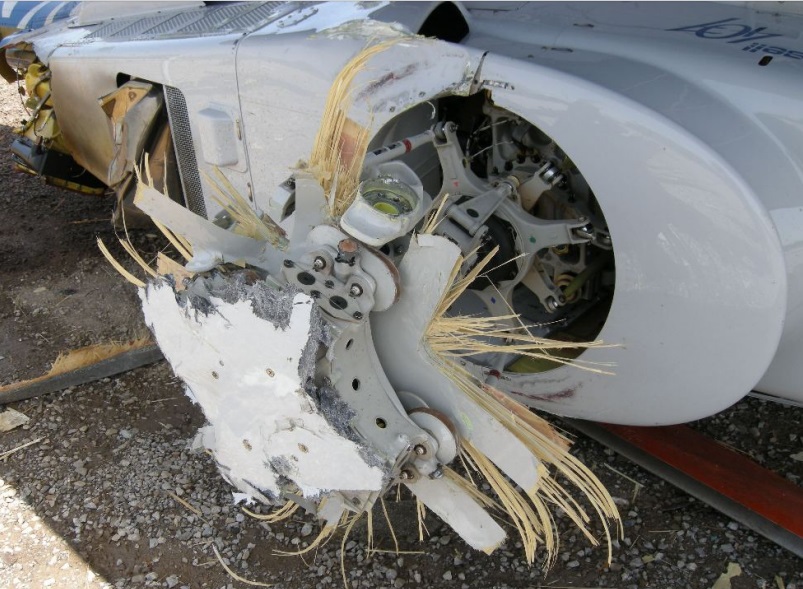
Wreckage of TVA B407 N427TV in Hickory, KY (Credit: via NTSB)
The Accident Flight
The US National Transportation Safety Board (NTSB) report:
A witness reported that there were no abnormalities…until it was approximately 75 to 100 feet above the ground. Suddenly, the main rotor tilted to the right. Immediately after, the entire helicopter banked to its right and fell to the ground on its right side, where it came to rest.
The pilot was killed in the impact.
The Safety Investigation
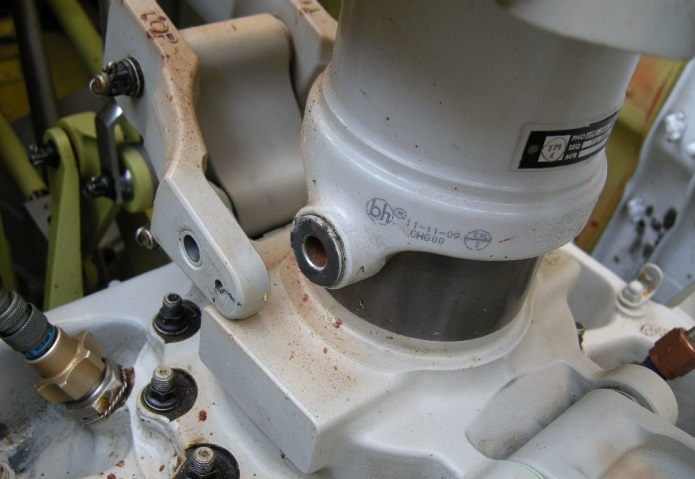
Initial examination of the wreckage revealed that the collective lever, which connected the cockpit collective controls to the main rotor, was disconnected from the pivot sleeve.
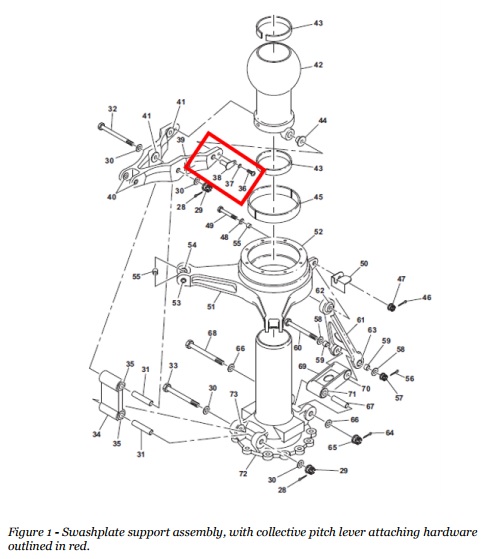
The collective lever is located to the front and bottom of the swashplate support. It is linked to the cockpit collective leaver and vertically moves the pivot sleeve to simultaneously change the pitch on all four main rotor blades.
The collective lever pins and screws that attached the collective lever to the pivot sleeve were missing;
…they were later found loose, near the main rotor area.
Collective Lever, As Found (Credit: NTSB)
The safety wires [i.e the wire locking] intended to secure the screws to the pins were missing. Examination of the hardware at the NTSB Materials Laboratory revealed that the safety wires not present, and the screws backed out over time, resulting in the complete loss of collective control in flight.
The NTSB elaborate:
The maintenance tasks performed during the inspections between May 31, 2016, and June 20, 2016 [38 flying hours previously], did not require the removal of the collective lever or the disconnection or inspection of the collective lever pins or screws. Although an inspection of the condition of the flight control bolts and nuts was one of the maintenance tasks performed, an inspection of the collective lever pins, screws, and corresponding lockwire was not included in that inspection.
The maintenance and inspections of the helicopter’s flight controls, including the collective control, were performed by two TVA airframe and powerplant mechanics and one TVA foreman, who assisted in the work and supervised the operation.
One of the mechanics re-installed an anti-drive lever assembly. He did not recall removing the lockwire on the collective lever pin screws or removing the pins. He stated that the other mechanic performed the 24-month inspection of the flight control bolts and nuts. He further stated that the collective lever pins were not part of that inspection.
The other mechanic performed the 24-month inspection of the flight control bolts and nuts. When asked if he removed the collective lever pins, he responded, “No, I don’t remember doing it. If anyone would have done it, it would have been me, but I don’t remember doing it.”
The foreman inspected the work performed in the area of the flight controls. He reported that the removal of the collective lever pins “…was not part of the required maintenance performed.” He was not aware that the pins were removed or that any lockwire was removed. He added further, “I could see why it could have been done. The 24-month flight control bolt inspection was being performed, why not pull them and look at them too. I’ve done it before.”
Both mechanics reported that they would occasionally be “pulled off” an aircraft to perform work on another project. One mechanic stated that there was a lack of documentation of what parts were removed, such as a continuation sheet.
Probable Cause
Company maintenance personnel’s inappropriate removal without replacement of the safety wires on the collective lever pin screws during a recent maintenance inspection, which resulted in the screws backing out and led to a loss of collective control in flight.
Safety Actions
Subsequent to the accident, the operator implemented numerous safety initiatives to prevent recurrence, including two independent safety audits, a formal fatigue risk management program, a safety management system, a formal tool/material accountability program, new work interruption policies, creation of a formally-trained safety officer position, and a formal process for the communication of safety-critical information.
UPDATE 24 June 2018:B1900D Emergency Landing: Maintenance Standards & Practices The TSB report posses many questions on the management and oversight of aircraft maintenance, competency and maintenance standards & practices. We look at opportunities for forward-thinking MROs to improve their maintenance standards and practices.
UPDATE 25 August 2018: Crossed Cables: Colgan Air B1900D N240CJ Maintenance Error On 26 August 2003 a B1900D crashed on take off after errors during flying control maintenance. We look at the maintenance human factor safety lessons from this and another B1900 accident that year.
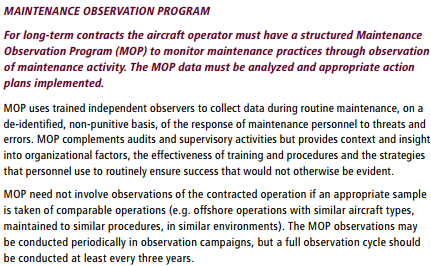
Aerossurance worked with the Flight Safety Foundation (FSF) to create a Maintenance Observation Program (MOP) requirement for their contractible BARSOHO offshore helicopter Safety Performance Requirements to help learning about routine maintenance and then to initiate safety improvements:
Aerossurance can provide practice guidance and specialist support to successfully implement a MOP.
Aerossurance sponsored the 2017 European Society of Air Safety Investigators (ESASI) 8th Regional Seminar in Ljubljana, Slovenia on 19 and 20 April 2017. ESASI is the European chapter of the International Society of Air Safety Investigators (ISASI).
Aerossurance has extensive air safety, operations, airworthiness, human factors, aviation regulation and safety analysis experience. For practical aviation advice you can trust, contact us at: enquiries@aerossurance.com