
Bo105 LOC-I in a Degraded Visual Environment & Water Impact (C-GGGC Canadian Coast Guard, Newfoundland 2005)
On 7 December 2005, while supporting lighthouse operations, Canadian Coast Guard (CCG) MBB Bo105 C-GGGC encountered heavy snow showers and impacted the water in Mortier Bay, east of Marystown, Newfoundland. Both occupants survived the impact and egressed the helicopter but died before they were rescued.
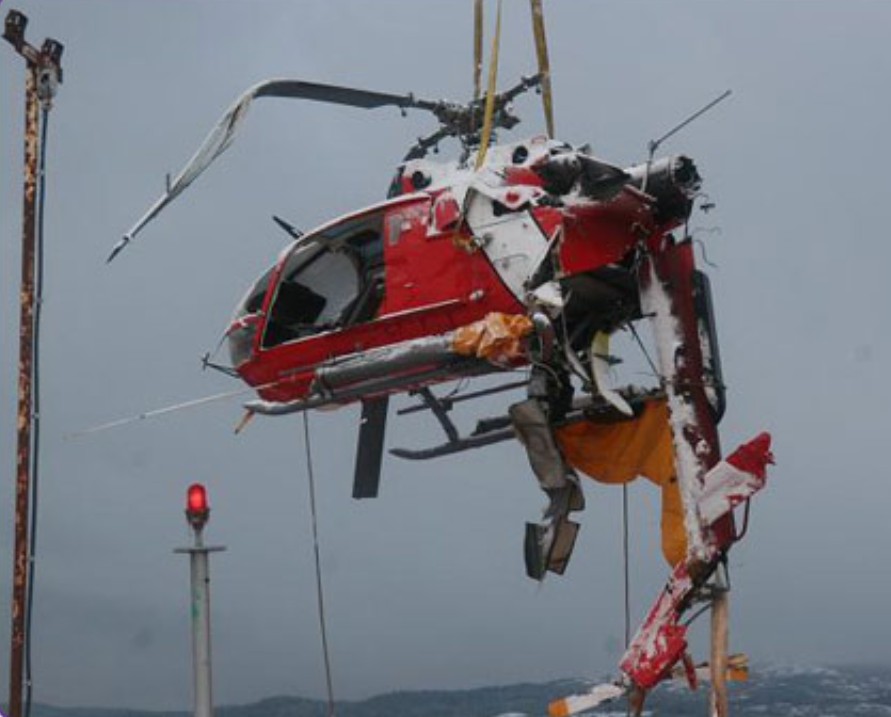
Recovery of the Wreckage of CCG / TC ASD MBB Bo105 C-GGGC (Credit: TSB)
The Transportation Safety Board of Canada (TSB) issued their safety investigation report
The Accident Flight
The helicopter, based in St John’s, Newfoundland and operated for CCG by operated by Transport Canada (TC) Aircraft Services Directorate (ASD), was first tasked to move personnel and cargo to the Green Island lighthouse, 7 NM off Burin Peninsula. It was then to proceed to Marystown, to pick up a CCG technician and shuttle them to various Aid to Navigation (AtoNs) around the Burin Peninsula.
The pilot had been flying helicopters for the CCG in Newfoundland for 27 years and had accumulated over 20,000 helicopter flying hours. He was not instrument rated and did not have a night endorsement.
The pilot filed a visual flight rules (VFR) flight plan, foreseeing a completion of the flying programme “by 15:00”. The TSB report later states 17:00. The helicopter departed at 10:29. During the morning the helicopter encountered snow and made an unscheduled shutdown at a shipyard at Marystown to await better weather. There was another weather delay, this time at Winterland Airport, in the afternoon. After completing the Green Island lighthouse tasking, the helicopter arrived at Marystown at c 14:52.
After collecting the technician the helicopter flew c 3NM to a small landing site at Go By Point, at the entrance to Mortier Bay. This site is on steep and rocky terrain next to an AtoN.
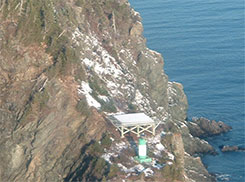
Go By Point AtoN & Landing Site (Credit: RTSB)
At 15:17, the pilot reported to the flight follower at the CCG’s Marine Communications and Traffic Services (MCTS) that they had landed at Go By Point, anticipating one hour of work on site.
While at Go By Point, the pilot took several photographs. Two photographs taken within 10 minutes of arrival showed sunny conditions, clear sky and unrestricted visibility. However, at 15:30, security camera at Cow Head (3.5 NM north) showed a heavy snow shower was underway. Snow was intermittent for about an hour and was light at the time of departure.
The exact time of the helicopter’s departure from Go By Point is not known as now radio call was received. The helicopter did a low orbit of Duck Island, just east of Go By Point, likely assessing the landing site for a visit the next day.
The helicopter then flew anti-clockwise around the shoreline of Mortier Bay as darkness approached. The helicopter would have gradually encountered heavier snowfall as it flew north. TSB explain that:
Once established on a westerly heading towards Marystown, it would have been difficult to turn around when severely reduced visibility was encountered because a turn to the right would have required flight into rapidly rising terrain with a possibility of encountering whiteout conditions. A turn to the left would have placed the helicopter out over the water and caused the pilot to lose visual contact with the coast.
When last observed by witnesses, the helicopter was about 1 NM east of Marystown, flying slowly at low altitude, in heavy snow and in near dark conditions.
The passenger was carrying a mobile phone, which was connected to the cellular network until 16:28. TSB say this is consistent with estimates of the time of the accident.
At 18:00, the helicopter was reported overdue to the Joint Rescue Coordination Centre (JRCC) by the Halifax Flight Information Centre (FIC) and a search initiated.
The bodies of the pilot and passenger were recovered from the water near Gould’s Cove later that night. The pilot died from hypothermia. The passenger drowned.
The TSB Safety Investigation
The examination of the helicopter did not reveal any technical anomalies. Therefore, this analysis will focus on environmental factors, the pilot’s decision to conduct the final trip to Go By Point and return, and the survival and organizational factors.
The TSB Safety Investigation & Analysis: Conduct of Flight
The weather encountered was generally consistent with the forecast but worsened while the aircraft was at Go By Point.
The pilot, who was highly experienced in these operations, had earlier dealt successfully with a snow squall in Mortier Bay. It is likely that the pilot believed that the trip to Go By Point and the return to Marystown could be completed safely and before dark.
With the need to maintain constant attention to outside visual cues, the pilot would have been experiencing an increased workload. This may have distracted him from selecting the particle separator, engine anti-ice, and continuous ignition switches that are required for flight in snow, and from arming the pop-out floats as he reduced airspeed below 60 knots in reduced visibility over the water.
Maintaining a reduced groundspeed in lowered visibility, as prescribed in the OM [Operations Manual], would have been difficult in the gusty downwind (30 knots) conditions over the water.
The pilot may have lost sight of land as the helicopter flew across the opening to Little Bay. Reduced visibility in darkness and re-circulating snow, lack of fixed visual references over the water, and turbulence may all have contributed to pilot disorientation.
It is likely that the pilot flared rapidly to slow the helicopter. The tail contacted the water heavily, breaking off and causing the subsequent loss of control.
The TSB Safety Investigation & Analysis: Helicopter Technical Examination
The helicopter was equipped with an underwater locator beacon (ULB). The ULB is designed to activate upon immersion and to transmit an acoustic signal at 37.5 kHz. This signal propagates well in water and is normally easily detected using portable hydrophone detection equipment. An intensive hydrophone search for the beacon was commenced on 9 December 2005, but the beacon signal could not be detected.
The area was then searched using side-scanning sonar with remotely operated vehicles investigating the sonar contacts. The helicopter was located on 17 December 2005, 1000 feet northeast of Big Head, in about 100 feet of water.
The close distribution of wreckage items on the sea bottom was consistent with a helicopter that was intact when it struck the water.
The helicopter was recovered on 18 December 2005 and was shipped to TSB facilities in Dartmouth, Nova Scotia, for further examination. Examination of the helicopter did not reveal any pre-existing mechanical abnormalities that could have contributed to the occurrence.
Both engines were operating at the time of impact. The damage indicated that both were delivering “significant power”.
Impact marks showed that there were two distinct collisions with the water.
The first impact was tail low, in forward flight. This impact tore open the cloth covering of the pop-out floats, and removed the spoiler from the lower belly of the helicopter. The tail boom, including the tail rotor, would have been immersed in the water. The tail boom was torn from the helicopter fuselage in an upward direction towards the right. The impact also deformed the engine and transmission deck, causing the failure of both engine drive shafts from the main transmission.
The helicopter then skipped off the water, and rotated because of the loss of tail rotor drive.
The second impact was rearward. Both of the front seats were found with their seat backs leaning markedly backwards. Also, the liferaft mount, which is located between the front seats, failed at the forward attachment bolts, pinning the liferaft firmly against the centre rear passenger seat.
The investigators note that:
The helicopter is certified for flight in falling or recirculating snow provided the particle separator, engine anti-ice and continuous ignition switches are selected to ON.
These switches were found in the OFF position.
Investigators examined the ULB:
When the ULB was placed in room temperature water, it transmitted normally. However, when the water temperature was lowered to near freezing, the signal quickly dropped off and was no longer detectable using the hydrophone detection gear.
A delamination of a metal coating on a ceramic resonating ring was found immediately beneath a solder joint.
The combined effect of the delamination and the cold temperatures was to remove the electrical connection to the ring, shifting the beacon signal frequency from 37 kHz to 166 kHz, which is beyond the detectable range of the locating equipment.
The TSB Safety Investigation & Analysis: Survivability
Also found OFF were the emergency flotation system arming switch.
Both emergency locator transmitters (ELTs) remained inside the helicopter and sank with it.
Had there been an ELT signal from the helicopter, naval and CCG rescue vessels were immediately available to respond.
The Operator’s Operations Manual (OM) required wearing lifejackets on any flight over water.
The pilot wore a lifejacket; the passenger did not, although there were several available inside the helicopter.
The helicopter’s internal liferaft remained inside the helicopter and sank with it. Its mounting had failed. The installation was certified to a certification basis that pre-dated the requirement to consider rearward or sideward impact forces. A liferaft was not required by Canadian regulation unless operating 50 NM or 30 minutes offshore.
TSB note that:
In a water impact or a capsizing event, the occupants of a helicopter face serious and immediate survival challenges. The need to escape from a capsized helicopter is immediate, but egress can be difficult due to injuries, disorientation, cold water shock, and/or the inability to breath.
The water surface temperature was just 6°C. Neither occupant was wearing a survival suit.
The pilot was wearing his CCG flight uniform, which had several layers. The passenger was wearing a one-piece insulated coverall.
Bizarrely the Canadian regulations required helicopter occupants to wear a survival suit at water temperatures <10°C but ONLY if the regulations also requited a liferaft. The OM was more stringent, requiring survival suits in multi-engine helicopters when>15 nm from a “ship, shore, or continuous ice capable of supporting the helicopter”. This did not apply to the route that day. But as TSB note:
For survivors in frigid water, the distance from shore is not relevant.
Neither occupant had received helicopter emergency egress/water survival training. The Canadian regulations did…
..not require this training, and it was not required by the operator. However, training was offered annually to ASD employees who wished to receive it.
Examination of the pilot’s helmet found that the end fitting of the communication cord was fractured. Test of a similar fitting required a 70-pound pull before the cord failed.
After water impact or a helicopter capsizing, a quick unimpeded egress through any available exit is vital to survival.
TSB comment that:
The existing regulations may be appropriate in the event of a successful controlled ditching, but they do not ensure protection during a capsizing event.
The TSB Safety Investigation & Analysis: Organisational Factors
TC ASD operates a mixed fleet of helicopters and fixed-wing aircraft. TC ASD supports helicopter and fixed-wing flight operations for the Department of Fisheries and Oceans Canadian Coast Guard.
TC ASD is considered a commercial air carrier but is unusual in being part of the same organisation as the aviation regulator. This will change in 2026.
The TSB note that a CCG / TC ASD Bell 212, C-GCHG, had crashed on 10 May 2000 while doing Helicopter Sling Load Operations (HESLO). The pilot died. TSB comment that safety deficiencies identified in that investigation continued to exist.
Another CCG / TC ASD Bo105 (non-fatal) accident had occurred to C-GCHX during HESLO on 7 May 2005.
The frequency of accidents and serious occurrences, the recurrence of identified operational shortcomings, and the lack of progress in mitigating several identified deficiencies are matters of concern that suggest organizational shortcomings at TC ASD.
Footnote: In 2015 we wrote of a further Bo105 accident involving a fatal Arctic Controlled Flight Into Terrain (CFIT) to C-GCFU that occurred on 9 September 2013.
TSB Findings
- The helicopter encountered a heavy snow shower and, while attempting to fly out of the snow, the pilot likely became disoriented.
- The pilot lost control of the helicopter when the tail broke off after contacting the water during a rapid flare.
- The survival equipment fitted to the helicopter sank with it, and was not available to aid the survivors after the accident.
- The occupants of the helicopter were not wearing sufficient personal survival equipment to enhance their potential survival in the frigid water.
Safety Actions
Among the actions taken:
TC ASD is in the process of implementing a Safety Management System, adding the position of an assistant chief pilot helicopter position and a flight operation quality assurance position all intended to improve, where necessary, existing communication, documentation,
and risk assessment practices.TC ASD and the Canadian Coast Guard (CCG) have established a Helicopter Operations Safety Working Group to review safety equipment, training, and procedures, and to make recommendations for improvements. This group has taken action on passenger helmets and survival equipment, and is reviewing the policy on wearing immersion suits as well as helicopter egress training.
There was a recall on affected Dukane ULBs.
Safety Resources
The European Safety Promotion Network Rotorcraft (ESPN-R) has a helicopter safety discussion group on LinkedIn. You may also find these Aerossurance articles of interest:
Dramatic Malaysian S-76C 2013 Ditching Video
NTSB Report on Bizarre 2012 US S-76B Ditching
Night Offshore Windfarm HEMS Winch Training CFIT (BK117C1 D-HDRJ)
BK117 Offshore Medevac CFIT & Survivability Issues
Fire-fighting Bell 204B Underwater Escape
Investigation into B212 Accident off UAE 7 September 2023
Hong Kong Harbour AW139 Ditching – HKCAD Report Issued
AAIB Report on the Ditchings of EC225 G-REDW 10 May 2012 & G-CHCN 22 Oct 2012
Firefighting K-Max Water Impact After A Close Pass by a S-64 Skycrane
Pitot Punctures Floats in Icelandic SAR Ditching
ADA AW139 A6-AWN Ditching off UAE, 29 April 2017: Final Report
AS350B3 Ditching Japan
Engine & Emergency Flotation Failures – Greenland B206L4 Ditching
Fatal Mi-8 Loss of Control – Inflight and Water Impact off Svalbard
Canadian Coast Guard Helicopter Accident: CFIT, Survivability and More
Lighthouse HESLO Accident
Dutch Maritime NH90 Caribbean Accident: Focus on the Survivability Issues
Korean Kamov Ka-32T Fire-Fighting Water Impact and Underwater Egress Fatal Accident
Recent Comments