
Schiebel Camcopter S-100 Water Impact (475, French Navy)
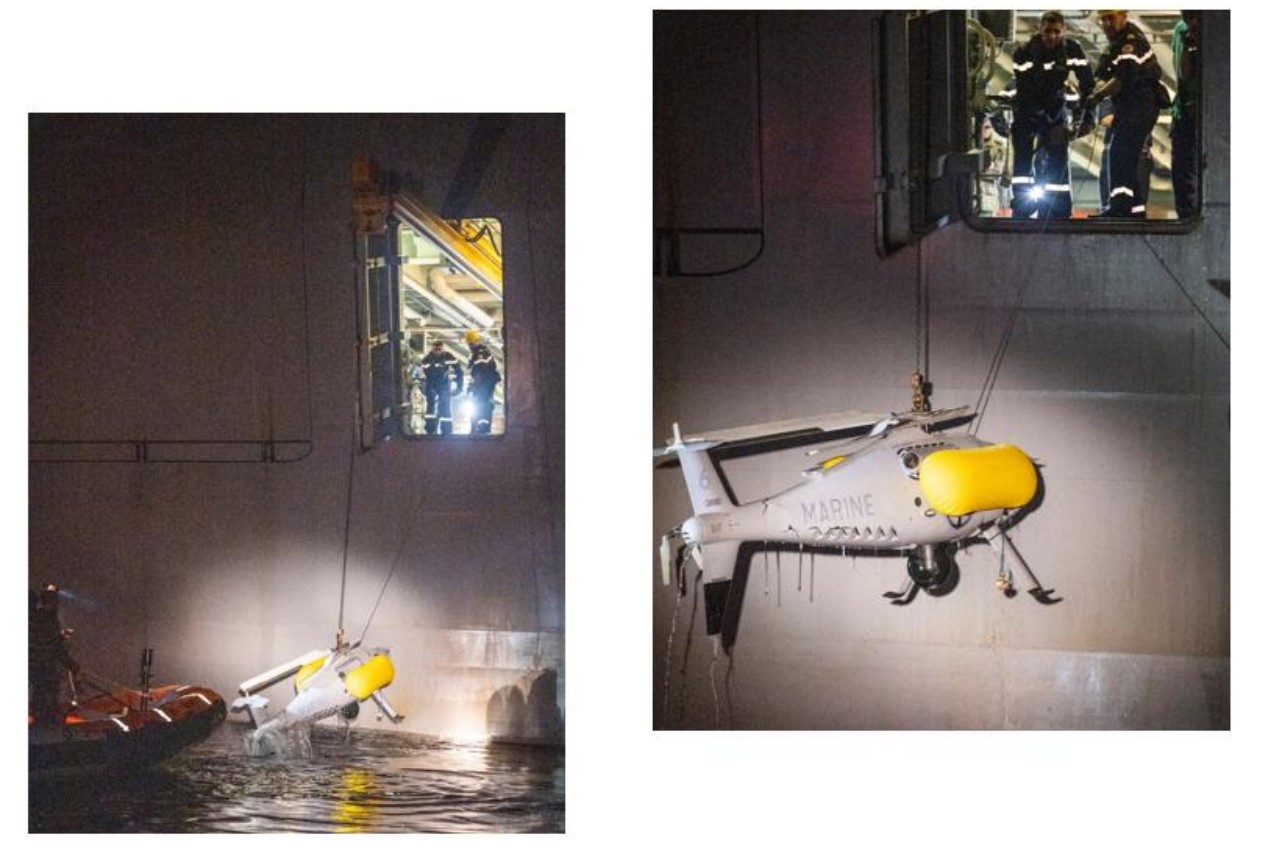
On 9 November 2024 French Navy Schiebel Camcopter S-100V2 rotorcraft Unmanned Air Vehicle (UAV) / Remotely Piloted Air System (RPAS) 476 of Flotilla 36F impacted the Gulf of Guinea 40 km South of Sao Tomé after engine issues during a night training flight from the Mistral-class amphibious assault ship Dixmude.
The Bureau Enquêtes Accidents d’État (BEA-É), the French state aircraft accident investigators, published their safety investigation report (in French) in March 2026.
The Accident Flight
While hovering after the second approach to the ship, the S-100’s operators observed a high engine temperature indication. A circuit was attempted to allow the temperature to reduce.
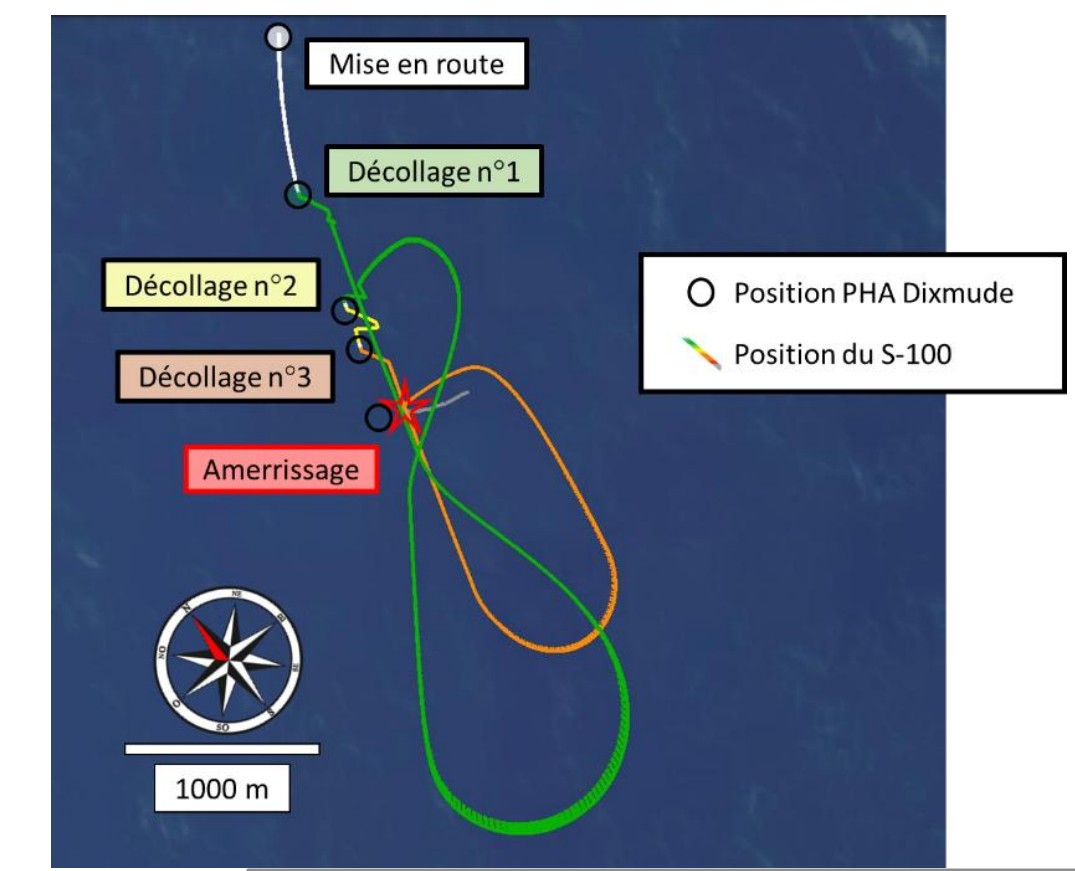
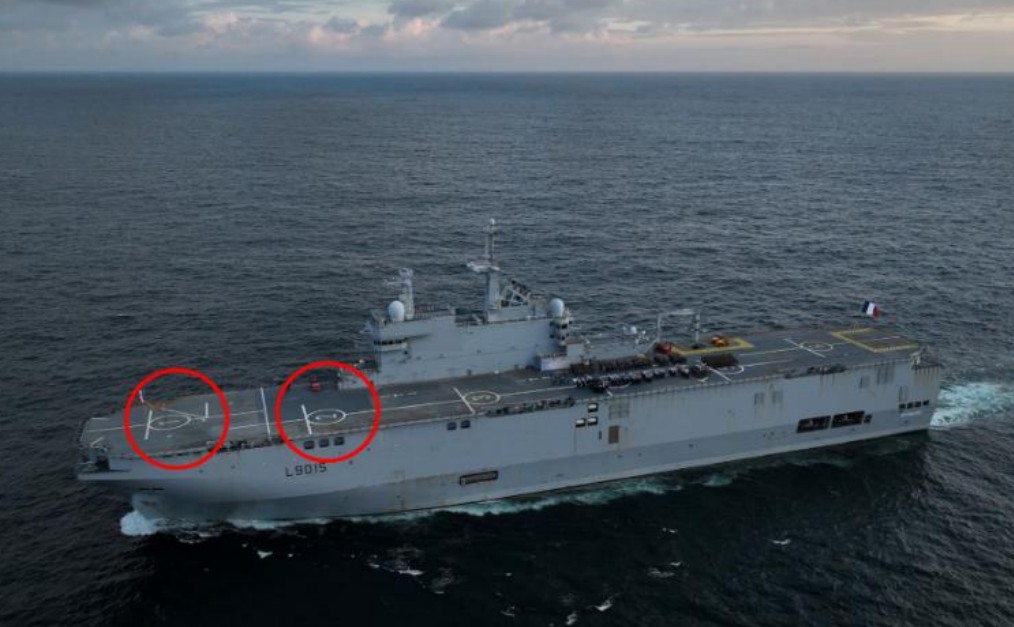
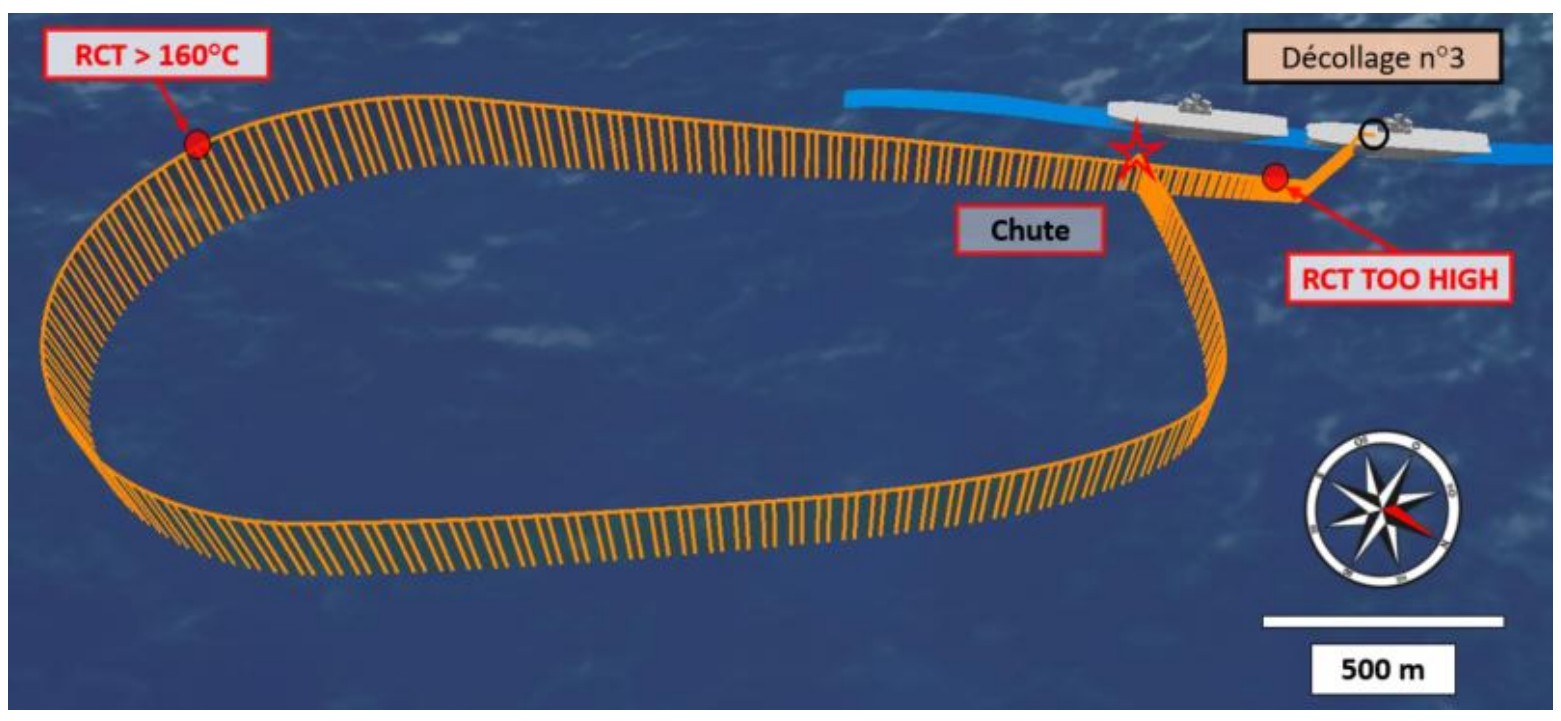
A warning for an excessively high temperature (‘RCT’) activated at 125°C and the temperature eventually exceeded 160°C (the upper limit of the sensor). The flight deck operator, who was also the remotely piloted aircraft commander (‘RPC’), announced an immediate emergency return to deck procedure to spot 2.
An “incandescent glow” was observed on the right-hand side of the aircraft as it approached the port side of the vessel. The S-100 lost height and impacted the sea.
The sea state was classified as ‘slight’. The drone’s Emergency Flotation System (EFS) was activated, allowing for its recovery within 40 mins.
The Safety Investigation
The S-100 was not equipped with a flight data recorder but the ground station records parameters transmitted live by the aircraft.
No anomalies were detected in the data for the first two circuits & landings, though engine and rotor speed both overspeed slightly at landing. This was considered normal by the OEM and consistent with the rotor pitch changing to provide a downforce when on deck. These overspeeds are however not readily apparent to the operators. Engine temperature was relatively high but consistent with the climatic conditions.
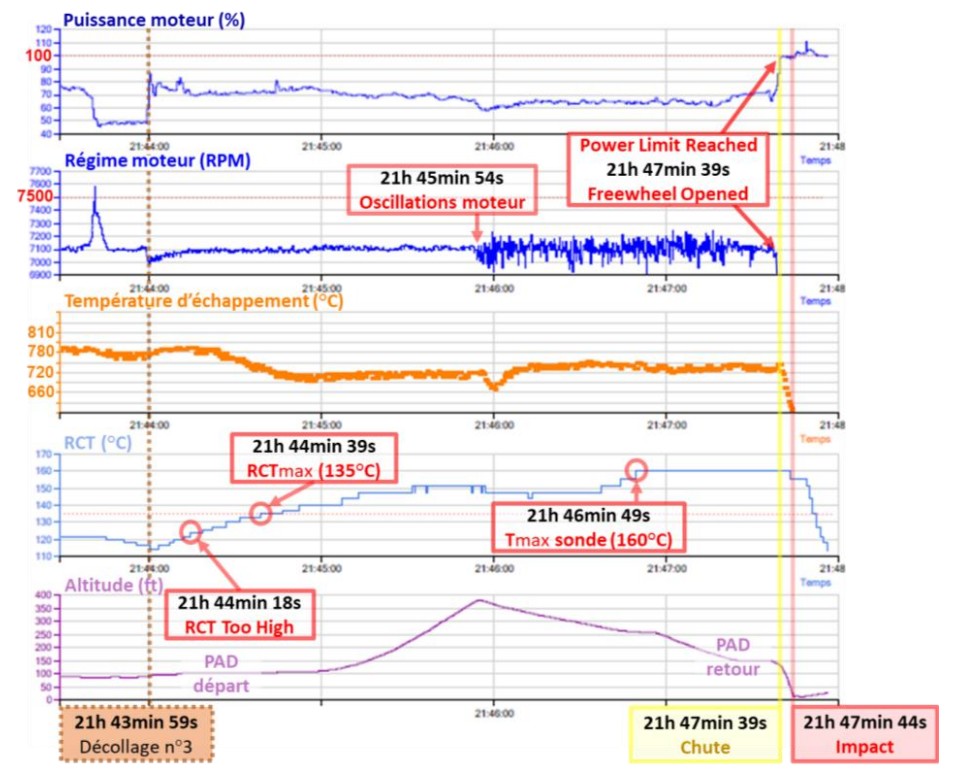
The S-100 flight data showed a rapid degradation of its engine parameters from takeoff #3, at
21:43:59:
- the RCT reaches 125 °C (RCT TOO HIGH) in 19 s then 135 °C (maximum limit) in 40 s after takeoff
- the exhaust temperature stabilized around 720 °C, with a transient drop to 660 °C
- significant fluctuations in engine speed appeared after 1 min 55 s of flight
- the temperature reached the probe’s measurement limit (160 °C) in 2 min 50 s
- the engine reaches its power limit and its RPM drops after 3 min 40 s of flight
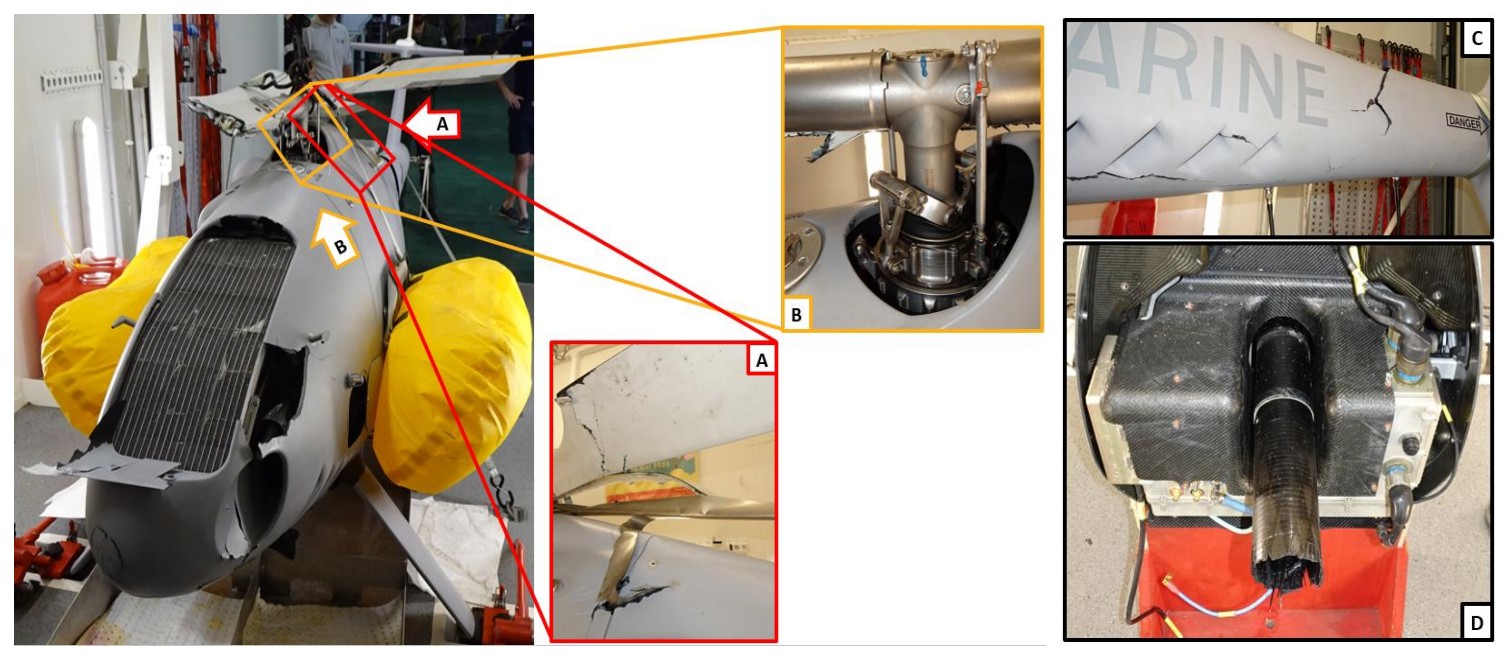
After recovery it was noted that:
- the fuel tank was pierced by a blade element on its upper part, left side (A)
- various rotor elements were displaced (B) and one blade bent (A)
- the tail boom was damaged (C)
- the rear driveshaft, made of carbon composite, was broken (D)
- the front fuselage and the various air intakes were heavily damaged.
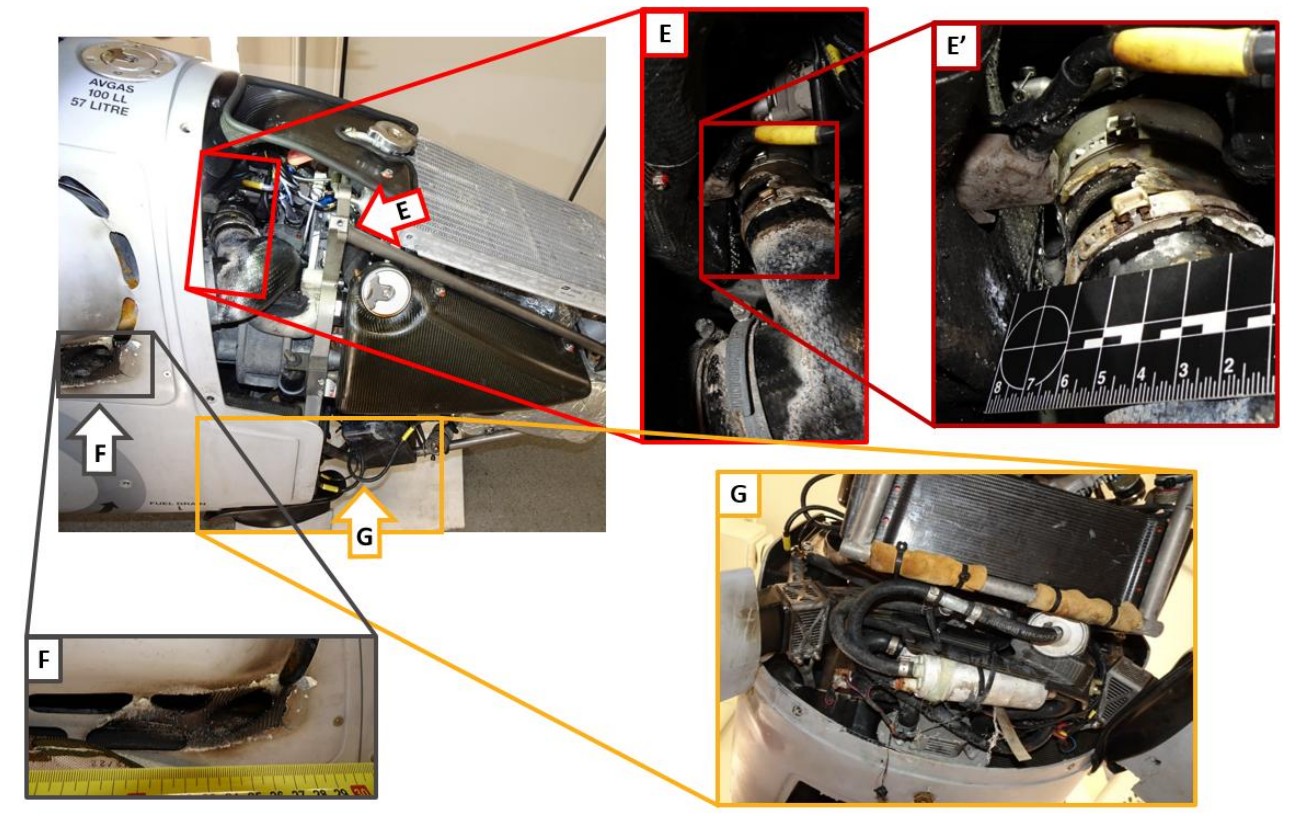
In the engine compartment:
- a 9 cm² hole was present in the engine air duct at the outlet (E to E’)
- there was damage to the entire exhaust system (destroyed lining and traces of high heat) at the oil drain outlet and at the exhaust outlet (F)
- the unburned oil drain hose was missing
traces of burning were found on the lower elements of the engine compartment (G) - the electrical connection of injector no. 2 (rear) was burned, the connection on spark plug no. 2 (rear) was missing and traces of short circuit were visible on spark plug no. 1 (front)
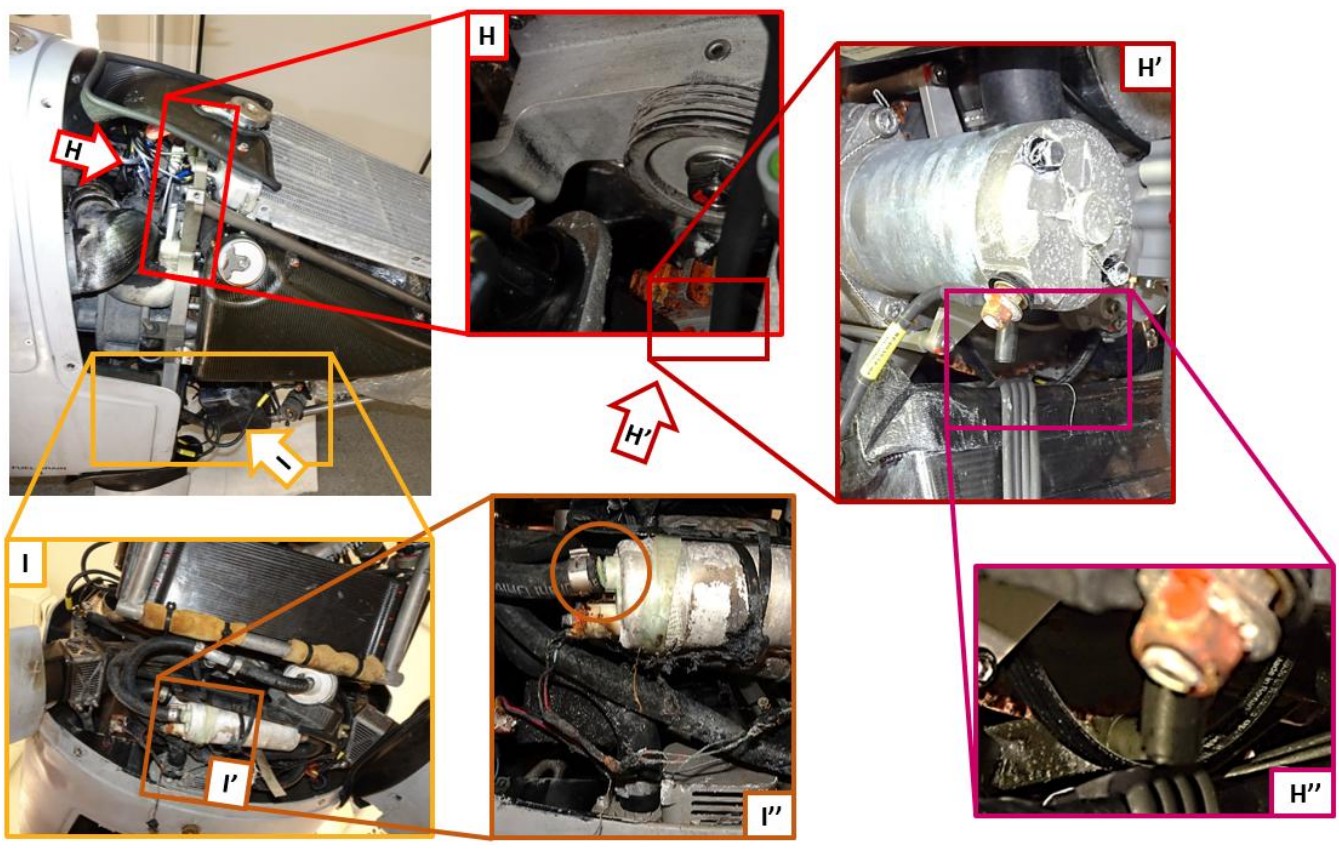
In addition:
- The engine air cooling system drive belt (aka the fan belt) was out of its housings, without apparent damage but turned over on itself (H to H”)
- the fuel hose is broken at the outlet of pump no. 1 (I to I”)
The fan belt was worn on its edges.
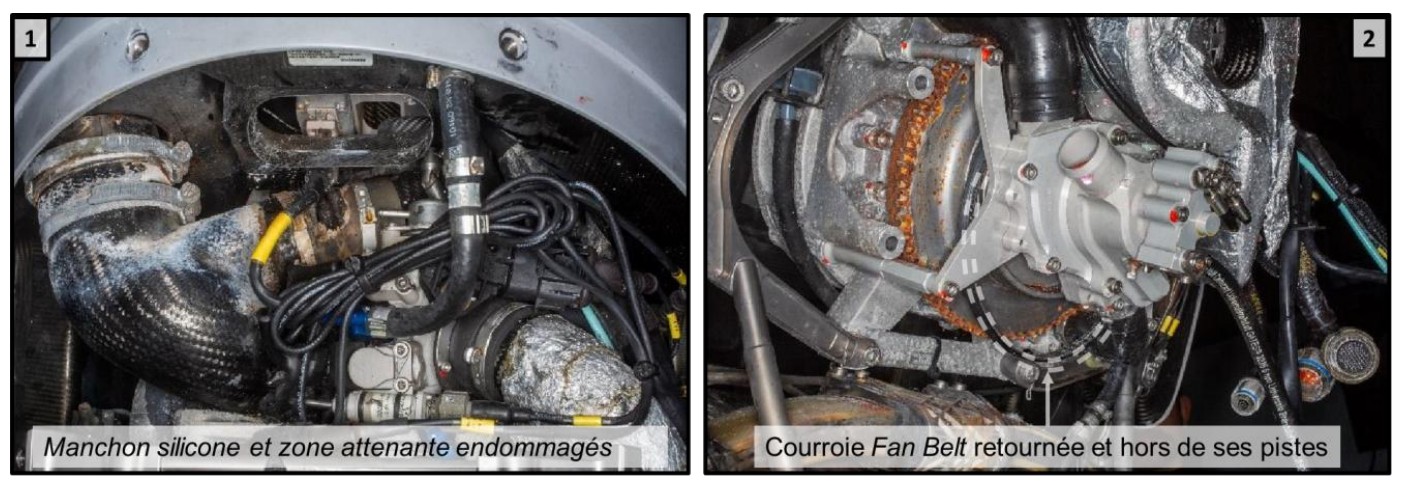 The damage observed on certain components of the engine compartment, particularly the exhaust manifold, was related to excessive heat. The cooling fan was found jammed but the jam was traced to corrosion of the fan bearing after immersion in the sea.
The engine was confirmed to have been running when the drone impacted the sea, though evidence indicated the beginning of an engine seizure.
The S-100 is powered by a 55hp Wankel rotary piston engine. Its cooling fan is driven at 21,000 rpm by the fan drive belt.
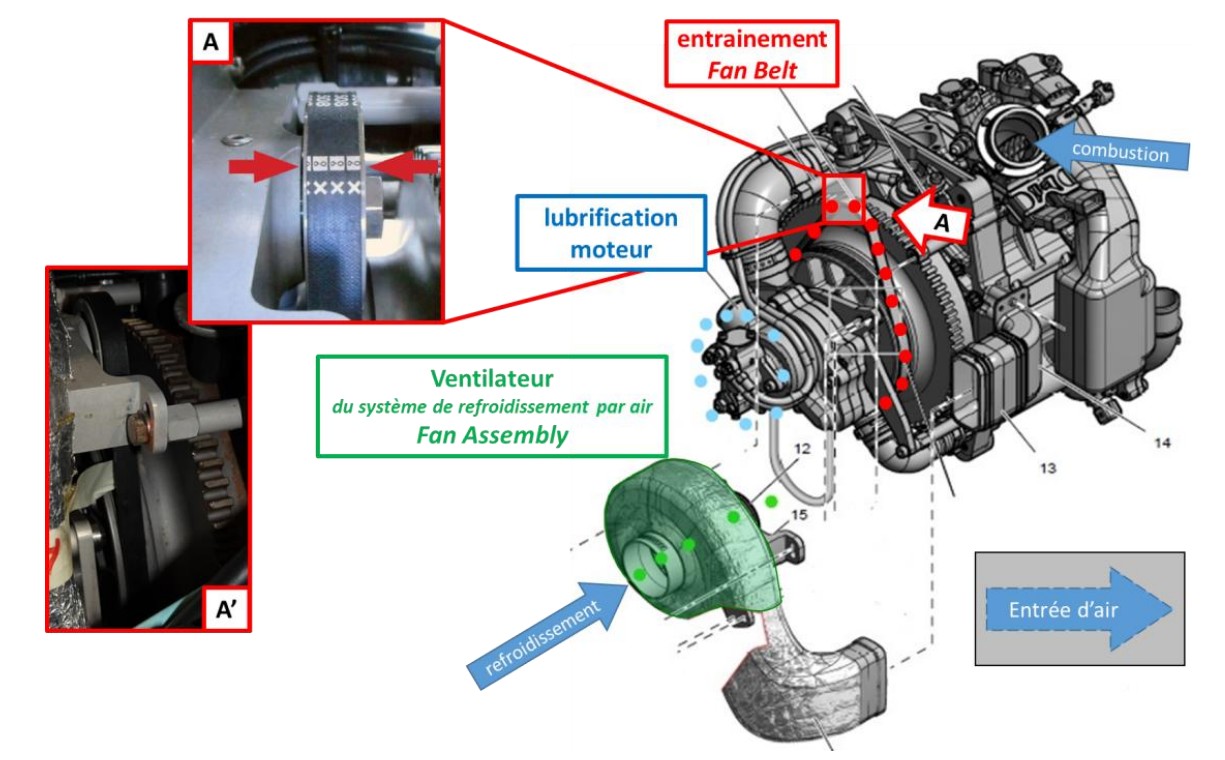 The fan belt fitted was the original design standard of belt and had been on the drone since the last engine change on 16 May 2024.
The tension of the fan drive belt is checked with an optical measuring device which measures the belt’s vibration frequency. To do this the technician must:
- take the measurement on the marked part of the belt
- place the measuring device at 3 to 10 mm from the belt
- hit the belt and measure the frequency using the device
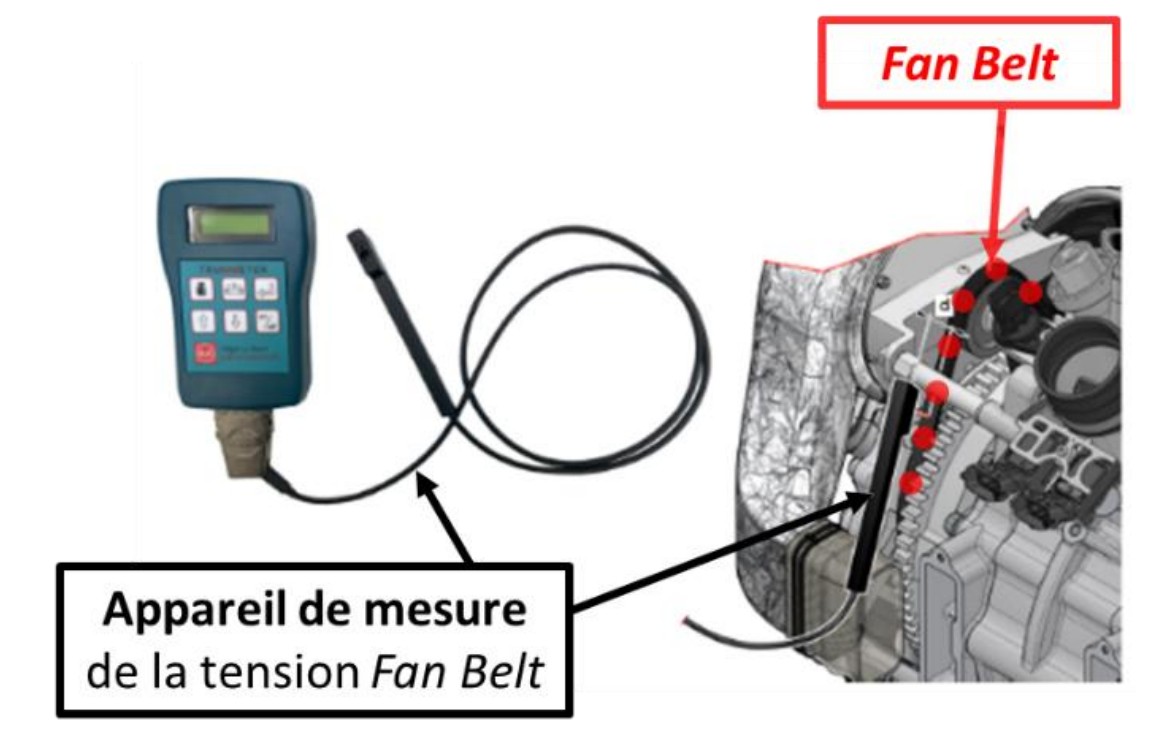 This check is carried out after installation then every 25 hours.
The acceptable frequency ranges for the original belt design are:
- 290 to 320 Hz on installation
- 160 to 350 Hz for a belt already in service
A belt is declared unusable if outside these ranges or if the belt shows damage.
The introduction of a new ‘Version 2’ fan belt started at engine overhaul in 2024, intended to increase resilience in response to prior in-service issues. For this build standard the revised procedures were follows:
- first make at least one complete turn of the belt
- take the measurement on the part of the belt with the marking
- use the measuring device and hold it at a distance of 1 to 3 mm from belt
- lightly tap or pinch the belt to cause vibrations to be read using the device
- three measurements must be taken and the average value calculated
This check is carried out after the assembly and then between again 1.5 and 7 hours of engine operation. Afterwards, it is checked every 25 hours. The frequency range criteria were now:
- 290 to 320 Hz for a new belt
- 260 to 320 Hz for a belt with less than 25 hours of operation
- 240 to 320 Hz for a belt with more than 25 hours of operation.
The BEA-E investigators concluded the worn fan belt had jumped one of its pulleys. With the fan no longer running, air cooling of the engine rotor was no longer ensured. Its temperature
then increased rapidly, leading to the damage observed in the engine compartment.
Deprived of its cooling airflow, the engine begins to seize due to the expansion of its rotor beyond acceptable limits, as evidenced by the observed damage to the engine rotor segments in the combustion chamber and the oscillations in engine speed.
During an engine seizure, the power delivered by the engine drops more or less abruptly depending on the engine’s rotational speed, potentially leading to its complete shutdown. Analysis of flight data shows that the engine reached its power limit and its RPM dropped sharply after 3 minutes and 40 seconds of flight, causing the aircraft to crash into the water.
The fan belt had 83 hours of operation and has had its tension checked three times, one of which resulted in an adjustment to 291 Hz on 6 October 2024. The last check was on the day of the accident. Crucially technicians do not have visibility of the belt’s edges when it is installed so could not have detected the wear investigators found.
On a belt drive, the portion of the pulley that is actually in contact with the belt corresponds to the overlap angle (expressed in degrees). The more the belt “wraps” the pulley, the better the grip, which limits slippage, allows torque to be transmitted without slippage, and reduces wear on the belt and pulleys. Conversely, too small an overlap angle reduces grip, increases the risk of slippage, and limits the transmissible torque, especially when the load increases or the belt is slack.
Their rated rotational speed is 7,100 RPM for the engine and 21,000 RPM for the fan, made possible by a size difference between the two pulleys; the fan pulley is approximately 3 times smaller than the flywheel. This results in a smaller overlap angle on the fan pulley, thus increasing the risk of belt slippage and derailment. With less overlap, lateral grip is reduced. The belt is more prone to slipping on the fan pulley and becoming misaligned, as the edges of the fan pulley are flush with the flywheel.
Consequently:
Due to the design of the air cooling system drive, the fan pulley presents a risk of slippage
and slippage of its drive belt, which can promote its derailment.Transient overspeeds of the engine rotor during landings cause an increase in load on the fan drive belt, contributing to its slippage fatigue and potentially leading to its derailment.
Safety Actions & Safety Recommendations
The French Navy transitioned to use the V2 belt on all their S-100s.
The BEA-E recommended:
- Schiebel ensure that the transient overspeeds encountered during landing do not cause premature wear of the fan drive belt
- Schiebel reassess the degree of urgency and the procedure associated with excessive engine temperature in the Pilot Operator Handbook, taking into account the criticality of the engine’s air cooling system and the rapidity of its deterioration due to excessive heating
- The French Navy conduct a reflection on the implementation of a “free deck” procedure during a drone emergency situation in order to ensure the safety of the flight deck environment (aircraft and personnel) including that of the operator at the controls who must maintain visual contact with the aircraft.
Safety Resources
The European Safety Promotion Network Rotorcraft (ESPN-R) has a helicopter safety discussion group on LinkedIn. You may also find these Aerossurance articles of interest:
- Schiebel Camcopter S-100 Engine Failure Results in Baltic Crash
- Drone Goes Walkabout: Hemispherical Human Factors Hiccup
- Software Bug and High Winds Down Drone
- Facebook Aquila Drone Accident: Gust Induced Structural Failure
- Drone Operation Injury
- USAF MQ-9A Reaper Lever Confusion: Human Factors
- Drone Pilot Injured in US Prison Geo-fence Incident
- Inspection UAS Collides with PNG LNG Export Jetty